

Data that is sufficient for day-to-day operations is not automatically suitable for AI. Aalen University is investigating how data quality can be assessed and improved as part of its AI data platform. The next step: a startup that will focus even more closely on this topic. In this guest article, Katharina Lechner describes what the founding team is working on and what kinds of industry partners they are seeking.
A new company is set to emerge from research at Aalen University: “DataQuality AI” aims to help companies, municipalities, and other organizations prepare their data for artificial intelligence. The startup team is now seeking interested industry partners for a planned EXIST grant application.
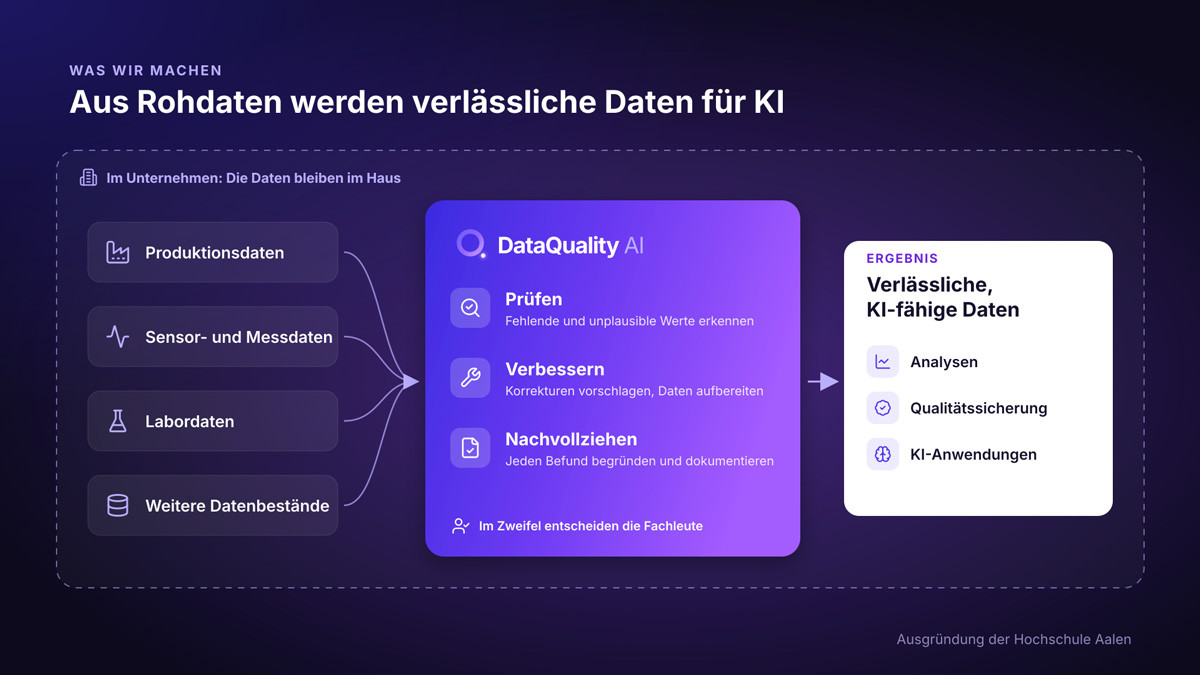
Artificial intelligence promises enormous possibilities: machines that provide early warnings of malfunctions; production processes that optimize themselves; hospitals that plan their resources more effectively; and local governments that deliver their services more efficiently. But before AI can take on such tasks, one fundamental prerequisite must be met: the data must be accurate. And this is precisely where the real challenge begins for many companies and organizations.
There's a lot of data, but is it suitable for AI?
Data is generated every day in virtually every company. Machines provide measurement values, sensors record operating conditions, and production facilities document processes. Hospitals, laboratories, and government agencies also process large amounts of information.
The problem: Data that is sufficient for day-to-day operations is not automatically suitable for training an AI. Measurement values may be missing, sensors may provide erroneous results, or data may be recorded inconsistently. Sometimes data is formally correct but does not make sense in the given context.
Here’s a simple example: The melt temperature of an injection molding machine remains constant at around 230 degrees Celsius during operation. Suddenly, the sensor briefly reports only 20 degrees—a value that is technically impossible during production; the sensor likely malfunctioned briefly. For a traditional database, this is initially just a valid number. An intelligent data quality check, however, should recognize that this value is implausible in context.
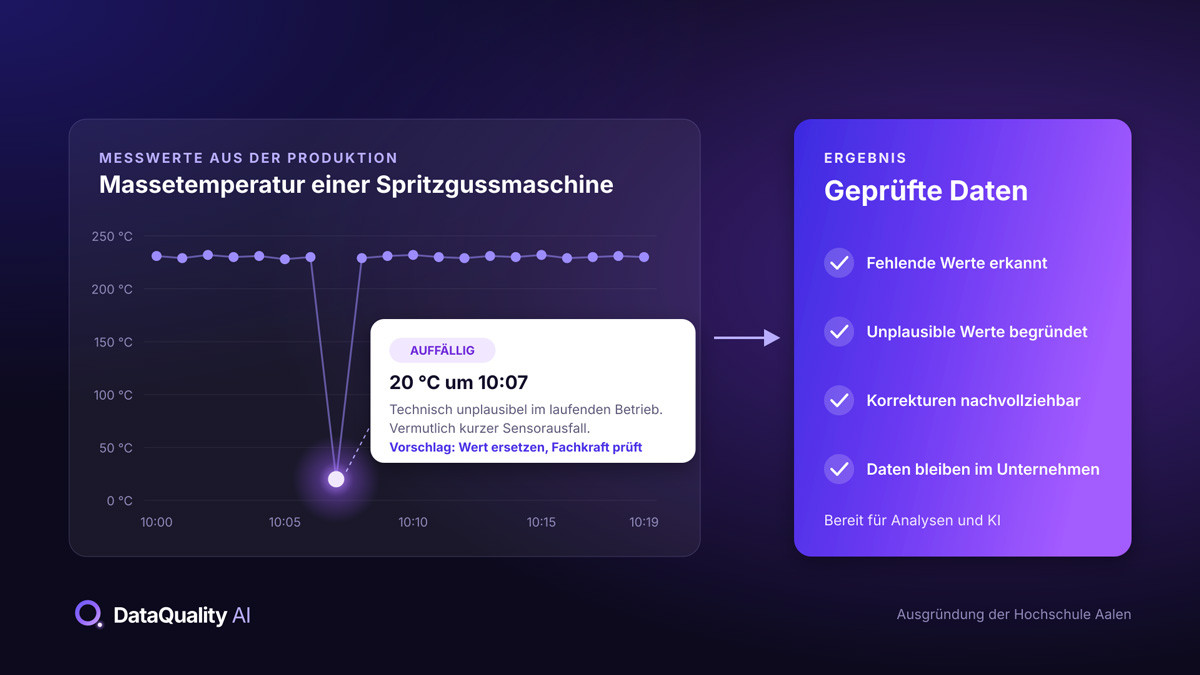
Such problems can lead to AI models potentially learning incorrect correlations, delivering unreliable results, or not being able to be trained effectively in the first place. Today, this verification is usually done manually: Experts review measurement series, write their own test scripts, and readjust rules and thresholds for every new machine, sensor, and material. This takes time and is often prohibitively expensive, especially for companies without their own data science team. That’s why it’s true that good AI doesn’t start with the algorithm—it starts with good data.
From Research to a Planned Startup
Aalen University is addressing this key topic as part of the AI data platform, which was released as open source by the Baden-Württemberg AI Alliance on GitHub for further use.
As part of the research project, research approaches were developed to automatically analyze data, detect anomalies, and improve data quality for AI applications. These include, among other things, machine learning techniques for anomaly detection as well as AI-supported methods designed to take into account the domain-specific context of the data.
What makes this approach unique is that, rather than relying on a single method, it combines statistical tests, machine learning, and an assessment of the subject-matter context. The goal is not only to identify that a value is unusual, but also to provide a clear, verifiable explanation of why it cannot be correct in the given context. A working prototype was already showcased at the Hannover Messe in 2024 and 2025, and the anomaly detection methods have achieved very high accuracy rates in laboratory tests.
This research is now set to give rise to an independent company: DataQuality AI. The planned startup aims to further develop the technologies into a practical software solution. The goal is to help companies and organizations systematically evaluate existing data, identify quality issues, and take appropriate steps to prepare the data. This should reduce the time spent on manual data verification and enable AI projects to get off the ground more quickly on a solid foundation. The software is designed to run within each company’s IT environment, ensuring that sensitive data remains on-premises.
The goal here is not to replace human expertise. On the contrary: the focus should be on combining automated testing procedures with employees’ knowledge of their processes and data.
Smaller companies, in particular, need more than just software
Large companies often already have their own data science teams. Many small and medium-sized businesses, on the other hand, are still in the early stages of adopting AI.
They ask themselves some very practical questions:
- What data of ours can we actually use for AI?
- Is our data complete and reliable enough?
- Do we need to collect additional information?
- How do we identify and correct incorrect data?
- What do we need to do before we can start an AI project?
DataQuality AI therefore plans to combine software with personalized consulting. As a first step, the company could work with a business to identify what data is available and which AI applications it is suitable for. Subsequently, data quality issues can be analyzed, and appropriate measures for improvement can be developed. For organizations that regularly collect and process new data, the software will eventually be available for standalone use—for example, through a licensing model. This approach is intended to provide a practical entry point even for smaller companies that do not have their own large AI department.
Not just of interest to the industry
Although the initial applications are planned primarily for the industrial sector, the issue of data quality is by no means limited to manufacturing companies.
Local governments and public administrations could, for example, benefit from this when consolidating different data sets or when preparing data-driven planning and administrative applications.
Hospitals and healthcare facilities face the challenge of reliably consolidating data from different systems and processes. Data protection, confidentiality, and careful technical review are particularly important in this context. Laboratories and research institutions often work with extensive measurement series, image data, and experimental results, the quality of which is crucial for subsequent analyses. Small businesses and medium-sized industrial companies could better process existing machine and process data to use it as a basis for developing, for example, quality forecasts or predictive maintenance.
The specific suitability of such applications will be examined in collaboration with interested partners in the field.
EXIST grant application in preparation
To develop a marketable offering based on the research findings to date, the startup team is preparing an application for the EXIST Research Transfer funding program. The program supports ambitious startup projects from universities and research institutions as they transition from scientific findings to a viable business.
The planned project aims to further develop these technologies, integrate them into user-friendly software, and test them under real-world conditions. A particular focus is on incorporating the requirements of potential customers at an early stage. To this end, the team is already seeking out companies and organizations that are familiar with data quality from their own experience and are interested in exchanging ideas.
Seeking Practice Partners
Would you like to implement AI in your company or organization, but aren’t sure yet whether your data is suitable for this purpose? Have you already launched AI projects and found that preparing your data requires more effort than expected? Or are you working with measurement data, production data, laboratory information, or other datasets whose quality you’d like to systematically improve? If so, the DataQuality-AI team would be happy to hear from you.
We are looking for companies, municipalities, hospitals, research institutions, and other organizations that are willing to share their needs and experiences in a non-binding discussion.
A non-binding letter of intent (LoI) in support of the planned EXIST grant application would be particularly helpful. This would allow potential practice partners to indicate that they consider the topic relevant and are generally interested in further discussion or possible future testing. Such a letter of intent is neither an order nor a financial commitment.
Even organizations that initially just want to learn more about the project are welcome to join us. After all, the best AI solution starts with a simple question: Can we trust our data?
Contact the planned founding team of DataQuality AI:
Katharina Lechner
Aalen University – Technology, Business, and Health
katharina.lechner@hs-aalen.de
+49 7361 576-2566
About the Author
Katharina Lechner is a project manager at the Regional Innovation Center for Artificial Intelligence at Aalen University and is part of the founding team at DataQuality AI.
About the Project
DataQuality AI is a planned spin-off from Aalen University. It stems from research conducted as part of the AI data platform. The application for the EXIST Research Transfer program is currently being prepared.
Behind DataQuality AI are Niloofar Aghajanpoor Kalashtari, Bhuvneshwar Bajpeyee, Omid H. Tavangar, and Katharina Lechner from Aalen University. Together, they bring expertise in artificial intelligence and machine learning, data science, data engineering, business administration, and innovation management. The team is supported by Prof. Dr. Heinz-Peter Bürkle as a mentor and Uwe A. Hermann as a consultant.