
AI Challenge results
From production planning and quality control to sustainable value chains: artificial intelligence is transforming entire industries.
The textile and clothing industry is also undergoing change. Six new project ideas presented at the AI Challenge Region Neckar-Alb, in collaboration with regional textile companies, startups, universities, research institutions, and industry associations, demonstrated how companies can actively leverage the advantages of new technologies to boost their profitability.
AI as a factor shaping the future of the textile industry – a traditional industry undergoing change
Our event partners
The Neckar-Alb Region AI Challenge "AI as a factor shaping the future of the textile industry – a traditional industry in transition" is a joint event organized by KI-Allianz Baden-Württemberg eG and Fraunhofer IOSB.
We would like to thank all our supporters and contributors, whom we will now name below:











The AI Challenge theme of our region
In the Neckar-Alb region, the focus is on the textile industry—which faces considerable structural challenges in the transition to Industry 4.0 concepts and technologies and the use of artificial intelligence (AI).
The region is traditionally dominated by SMEs, which means that only limited investment budgets are available for costly digitization projects. Many companies have to carefully weigh up the cost/benefit ratio in order to decide which innovations and technologies they can implement.
At the technological level, the digitization of the textile production chain is a complex task. The integration of sensors, the networking of different systems, and real-time data collection require considerable investment.
Integration into existing machine parks from different generations and manufacturers is particularly challenging.
The introduction of AI brings with it further specific challenges, as it is accompanied by a transformation process. AI systems for textile design, quality control, predictive maintenance, or process optimization require large amounts of high-quality data and specific expertise. Data security in networked production environments is critical, as sensitive production data and intellectual property must be protected.
Our topics
In interactive workshops, solutions were developed for four key topics – all with direct benefits for the Neckar-Alb region:
Topic #1 - Data rooms
Material data rooms (B2B)
Material data rooms in the B2B sector enable the management and use of material and process data along the entire supply chain. They create the basis for material simulations and virtual testing of product properties, including the evaluation of recyclability and sustainability.
In the context of Industry 4.0, they support the creation of interoperable digital twins of materials, machines, and processes. This enables on-demand production based on end-to-end process and data chains from design and procurement to production. A key step in this process is the transition from fragmented data silos to genuine data spaces, which addresses issues of governance, standards, and interoperability.
In addition, specifications, certificates, and quality assurance data are seamlessly integrated. The goal is secure, interoperable data exchange between suppliers, manufacturers, and testing institutes, as well as end-to-end IT support from design to production.
Topic leader: Boris Schnebel (Fraunhofer IOSB)
Textile data rooms (B2C)
Consumer-oriented textile data rooms (B2C) make it possible to equip textile products with a digital product passport and a unique "fingerprint" to ensure transparency, traceability, and sustainability throughout the entire life cycle. On this basis, products can be designed with the customer in mind and personalized right down to on-demand production.
Virtual tests and experiences—such as the visualization of product features or the use of digital twins in commerce—are creating new forms of product perception and evaluation in the digital space. This requires consistent data flows within the company and to end customers, retailers, platforms, and service partners, so that all relevant information can be seamlessly integrated and utilized.
Topic leader: Jan Burke (Fraunhofer IOSB)
AI-based plausibility check

DEVELOPMENT
Project objective
The project is developing an AI-supported system for plausibility checks of measurement and material data in order to significantly reduce production errors, planning errors, and unnecessary feedback loops in the textile value chain and to sustainably improve data quality.
DEVELOPMENT
AI system and data
AI methods:
- clustering process
- plausibility models
- Model fine-tuning
database
- Anthropometric measurement data
- material data

Value proposition
- Fewer production errors and complaints
- Faster decisions thanks to automatic plausibility checks
- Reduced queries and loops between measurement, planning, and production
- Lower material and labor costs in development and manufacturing
- Better database for further AI applications and material data rooms
OPERATION
Business model
In the short term, the AI system will be used as an internal optimization tool:
- internal efficiency gains
- Embedding as a module or service in existing specialist software
In the medium and long term, the solution can mature into a licensable AI building block.
Offered as a B2B service for clinics, medical supply stores, textile manufacturers, and fabric suppliers (e.g., as a SaaS module for plausibility checks).
OPERATION
Resources and partners
Partners:
- Clinics and medical supply stores
- R&D departments
- suppliers
- internal departments
Resources:
- Anthropometric measurement data
- Materials and recipe
- expertise
In the two fields under consideration—the provision of medical compression stockings and textile product development—a vast amount of measurement and material data is collected every day. However, this data is prone to errors: misinterpreted body measurements, mixed-up entries, or inappropriate material combinations lead to production errors, customer complaints, and time-consuming back-and-forth communication between clinics, medical supply stores, manufacturers, R&D departments, and suppliers. Plausibility checks are usually performed manually and depend heavily on the experience and daily performance of the employees.
The "AI-based plausibility check" project systematically uses existing data sets to address this bottleneck. In the medical context (variant A), AI analyzes historical and current anthropometric measurement data, recognizes typical body profiles, and flags new measurements that do not match the ordered products or are contradictory. At the point of care, specialists receive real-time feedback on whether the values entered appear plausible or whether they should be remeasured. This avoids costly production errors and stressful complaints without affecting the ultimate decision-making authority of the specialists.
In textile development (variant B), a "material wizard" is being developed based on extensive fabric and ingredient databases. It evaluates new material combinations in the sampling phase in terms of plausibility and risk, for example with regard to weight, elasticity, or robustness for a specific application. Unusual combinations are highlighted, and alternatives can be suggested based on similar, already proven materials. This reduces the need for physical samples and trial runs, saves material and working time, and supports data-based decision-making.
The two variants create a reusable AI module for plausibility checks that can be integrated into various systems along the textile supply chain. It creates a consistent database, improves quality and efficiency, and at the same time forms an important building block for future material data rooms, digital twins, and other AI applications in the textile industry.
DigitAllSample
DEVELOPMENT
Project objective
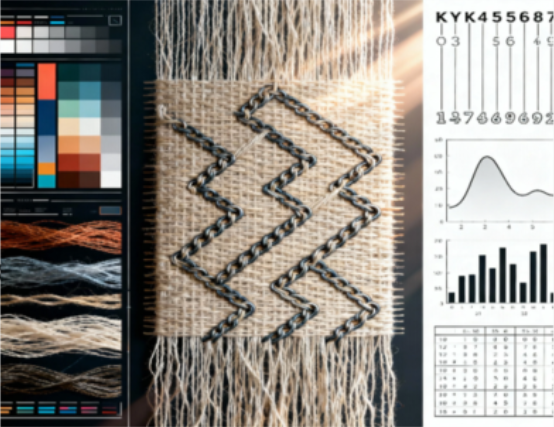
- Predicting the usability of new textile designs for garments
- Time, money, and resource savings for suppliers
- Time and money savings for the customer
DEVELOPMENT
AI system and data
Input sizes:
- Design configurations
- Test data (possibly reduced/standardized set after correlation analysis)
Output sizes:
- probability of suitability
- possibly according to adjustable thresholds for parameters such as tear resistance, etc.
Value proposition
- mutual benefit: lose/lose -> win/win
- significant cost reduction
- speed
- improved material resource efficiency
- risk mitigation
OPERATION
Business model
- cost reduction
- Internal maintenance and further development of the database
- Suitability dashboard: quick, automated decisions on usability during the design phase
OPERATION
Resources and partners
Resources:
- metric test results (large historical database)
- sales figures
Partners:
- Design department at suppliers
- Purchaser at the customer's premises
- Data Scientist / AI Developer
Topic #2 - Sustainability
Sustainability requirements in the textile industry (apparel and technical textiles) are becoming increasingly prevalent and a key competitive factor. These include AI-driven demand forecasting for materials and production resources, as well as process optimizations aimed at reducing consumption—for example, of water and chemicals. A key factor here is the integration of market and procurement to optimize production and avoid surpluses.
To implement regulatory requirements more efficiently, AI-powered sustainability reports (ESG reporting) and the creation of digital product passports for documentation and decision-making are essential. Tools for forecasting sustainability (e.g., regarding resource consumption and carbon footprint) are essential for optimizing resource use, avoiding overproduction, and enabling demonstrably more sustainable textile production.
Session Chair: Christian Kludt (Fraunhofer IOSB)
AIassure – AI-assisted sustainability reporting
DEVELOPMENT
Project objective
- Automated CSRD reporting with dynamic adaptation to changing regulations
- Unified data management as a single point of source
- Interactive, language model-assisted system
DEVELOPMENT
AI system and data
- Master data in the ERP system
- Project and document management
- Commercial databases (GABI, EcoInvent)
- LLM-based chatbot

Value proposition
Complete and largely error-free reports
- Clear responsibilities
- Identifying information gaps
- Efficient process with continuous improvement
- Plausibility check by subject matter experts
OPERATION
Business model
Internal financing, possibly in cooperation with other companies or as a funded project
- Initialprojekt für thematischen Durchstich: <= 100T€
OPERATION
Resources and partners
Key User
- core team
- Time required: 6 months
Many companies in the textile industry today face complex challenges in sustainability reporting. Ensuring data integrity and complete traceability across the entire value chain requires considerable resources. At the same time, collecting, consolidating, and managing sustainability data from different sources and systems is time-consuming and prone to errors. In addition, future developments such as recyclability, material consumption, product longevity, and carbon footprint are difficult to predict.
AIassure addresses these challenges with an interactive, language model-assisted reporting and aggregation system. The solution combines AI with intuitive usability, allowing users to interact with the system in natural language. Complex data analyses are automated, and precise sustainability metrics are available at the touch of a button.
AIassure's goal is to comprehensively automate reporting while reducing manual processes and speeding up report generation. The system dynamically adapts to changing regulatory requirements such as the EU Directive on Sustainability Reporting (CSRD). As a single point of source, it provides a central, reliable data source for all sustainability information, thus laying the foundation for future-proof, target group-specific sustainability reporting.
Topic #3 - Production quality and efficiency
Various approaches must be combined to stabilize production quality, reduce scrap, and increase plant efficiency. Inline quality prediction and monitoring allow quality deviations to be detected and corrected during the production process, significantly reducing scrap. In addition, predictive maintenance enables the early identification of wear and tear and potential plant failures, allowing maintenance work to be planned and unplanned downtime to be avoided.
Forward-looking and capacity-based production planning takes into account both available resources and future requirements in order to ensure optimal utilization. By combining these measures, a sustainable increase in production efficiency is achieved while simultaneously improving the quality and availability of the equipment.
Topic leader: Benedikt Stratmann (Fraunhofer IOSB)
TexMaintAIn - Predictive maintenance in textile production

DEVELOPMENT
Project objective
Install new sensors
- Integrate anomaly dashboard (including alerts and thresholds)
- Learning and modeling machine trends (data preparation, baselines, validation)
- Train plant operators to interpret anomaly detections and respond appropriately
DEVELOPMENT
AI system and data
Statistical best practices for time series anomaly detection
- Proprietary data sources for each component type (e.g., pumps, motors, controllers) with data catalog and access rights
- Installation of new sensors for external machine monitoring (vibration, temperature, power consumption)
Value proposition
More efficient procurement of replacement and repair parts (proactive orders, shorter downtimes)
- Greater transparency regarding the current status of the machines in the dyeing plant
- Greater planning accuracy for production lead times in the dyeing plant
- Reduction and improved predictability of energy consumption (avoidance of peak loads)
- Fewer production downtimes thanks to early fault detection (higher availability/OEE)
OPERATION
Business model
More dyeing in less time and with lower repair costs (preventive maintenance, faster availability of spare parts)
- Reduction of downtime in the internal cost center "Dyeing" -> higher maximum capacity/OEE
OPERATION
Resources and partners
Sunius (software provider)
- Production Manager
- Maintenance Technician
- logistics
Yarn dyeing is a critical and error-prone step in textile production. This often leads to downtime in order to resolve problems. Due to the many machine parts involved, the number of possible sources of error is very high.
In order to detect errors at an early stage and prevent downtime, TexMaintAIn will be used to monitor the wear and tear of the plant's main components – pumps and motors. Existing sensors will be used for this purpose, and additional sensors will be installed if necessary, in order to identify components that are operating outside the norm and are likely to fail in the near future with the help of trend analyses and anomaly detection.
This information can be used to proactively order spare parts and plan maintenance cycles in order to avoid sudden and prolonged downtime, thereby increasing production capacity utilization and process reliability.
PROFA – Production Error Assistant

DEVELOPMENT
Project objective
Development of an assistance system for fault diagnosis in textile production and textile logistics.
DEVELOPMENT
AI system and data
Retrieval-Augmented Generation (RAG) assistance system:
- Database: documented errors and solutions
- Knowledge database as RAG basis for assistance system
- Language model as an interface between humans and knowledge databases
Value proposition
Problems are solved more quickly
- error prevention
- Prevention of production downtime/production losses
- knowledge preservation
OPERATION
Business model
Cost reduction through less production waste
- Higher input due to less downtime
- Less overtime due to less rework
OPERATION
Resources and partners
Resources:
- Historical error logs
- Experienced staff to complete the database
- data infrastructure
Partners:
- In-house production
- suppliers
Textile production is characterized by a highly dynamic production and logistics process. As a result, troubleshooting becomes a complex task that relies largely on experience and requires a lengthy training period. In this context, the departure of long-serving and experienced employees—and the resulting loss of expertise—leads to slower and less effective problem-solving. Some documentation on problems and potential solutions already exists, but it is neither complete nor structured. This makes it difficult to train new employees using this documentation, and experienced employees remain the primary source of information.
The project's approach PROFA project is to complete the largely unstructured documentation with the help of experienced employees and make it accessible to new employees using a language model assistant. This allows new employees to be trained more quickly and ensures that expertise is preserved in the long term. Based on this data, systematic errors can also be identified more easily.
StruMon 4.0 – Monitoring the production of compression stockings

DEVELOPMENT
Project objective
Transparency, documentation, and risk minimization in the measurement process
- Long term: Predict product quality and optimize plant configuration
- Establishing integrated control technology in accordance with Industry 4.0
DEVELOPMENT
AI system and data
Optical measurement technology
- at the measuring station
- inline
- Control technology/sensor technology
- ERP and order data
- Data management (sensor data and quality data)
Value proposition
High-quality product for patients
- Predict product quality to minimize errors
- Customizable for all item types
- Integrated view of the entire plant, including the surrounding area
- Use of Industry 4.0 / IT standards where appropriate
- Economical and value-adding use of a digital product passport
OPERATION
Business model
Cost optimization through error prevention and waste reduction
- energy savings
- Software licenses (optional)
OPERATION
Resources and partners
Machine manufacturers
- Automation Engineers
- IT service providers
- Software developers
- AI developers
The manufacture of medical compression stockings places the highest demands on quality and precision, as these products directly affect the health and well-being of patients. The exact pressure distribution over the entire length of the stocking is crucial for therapeutic effectiveness. Even the smallest deviations in knitting density, thread tension, or material composition can impair the medical function and, in the worst case, pose health risks for the wearer.
StruMon 4.0 is an intelligent monitoring system that monitors and documents the entire production process in real time. The system continuously records relevant production parameters such as machine speed, thread tension, knitting speed, and temperature on the circular knitting machines. Through the integration of sensor technology, quality characteristics such as stitch pattern, fabric length, and pressure distribution are ideally checked during production (inline). StruMon automatically detects deviations from the target value and immediately alerts the operating personnel so that corrective action can be taken in a timely manner.
The first step aims to improve quality assurance in the textile industry in the manufacture of compression stockings through digitalization and integrated order data and quality data management. The challenge lies in integrating this into the existing process. In the medium term, StruMon 4.0 plans to use AI models to proactively avoid errors and predict product quality.
Become part of our network!
The community management team at KI-Allianz Baden-Württemberg specifically connects business, science, and politics in the regions to promote the exchange of knowledge and the application of AI technologies. The community management team at KI-Allianz is also represented in the Neckar-Alb region.
Are you interested in a particular result or topic and would like to learn more or get involved?
Then please contact our community management team for the Neckar-Alb region:
Nils Mano
nils.mano@ki-allianz.de
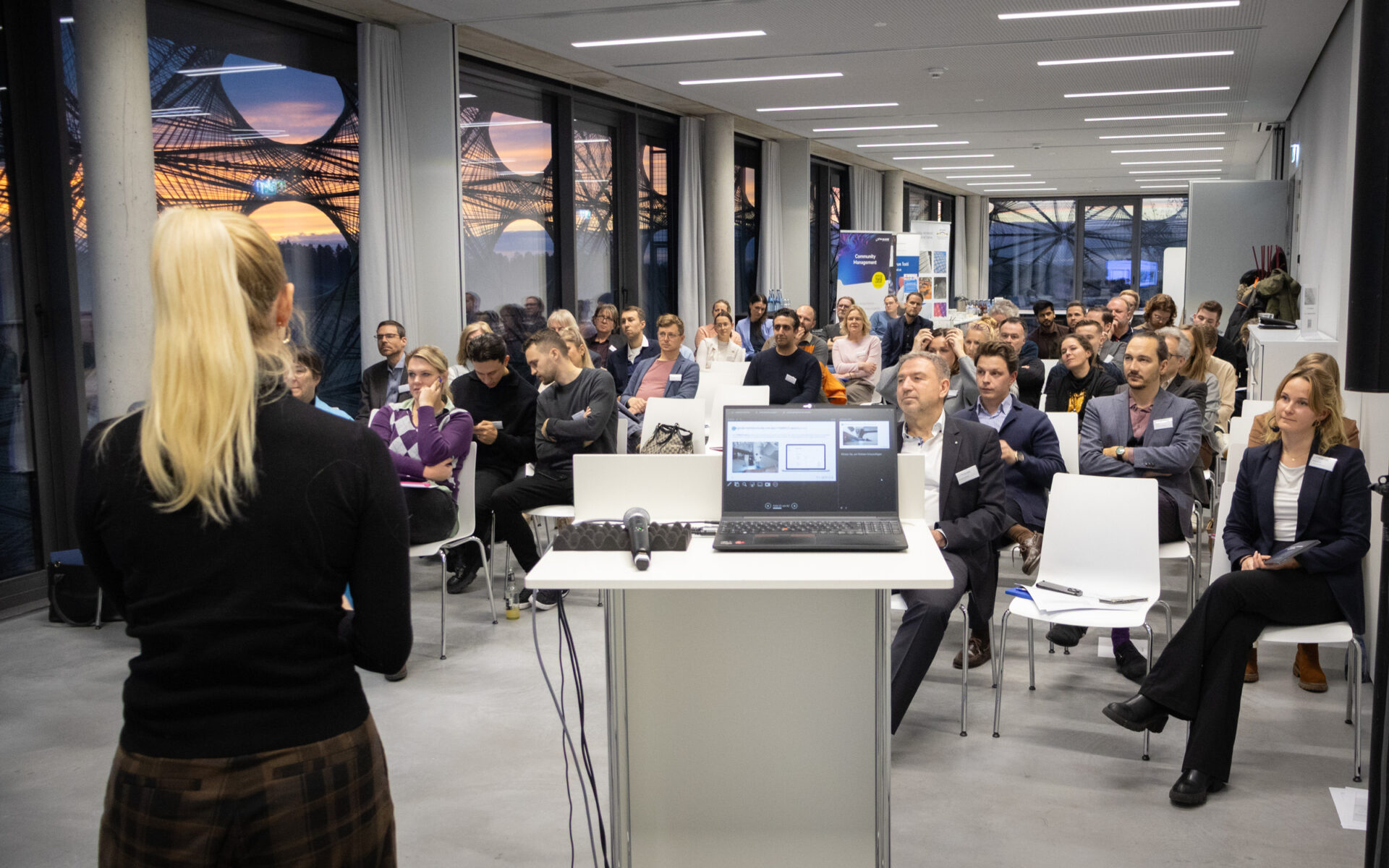
Impressions and comments from "AI as a future factor for the textile industry – a traditional industry in transition"
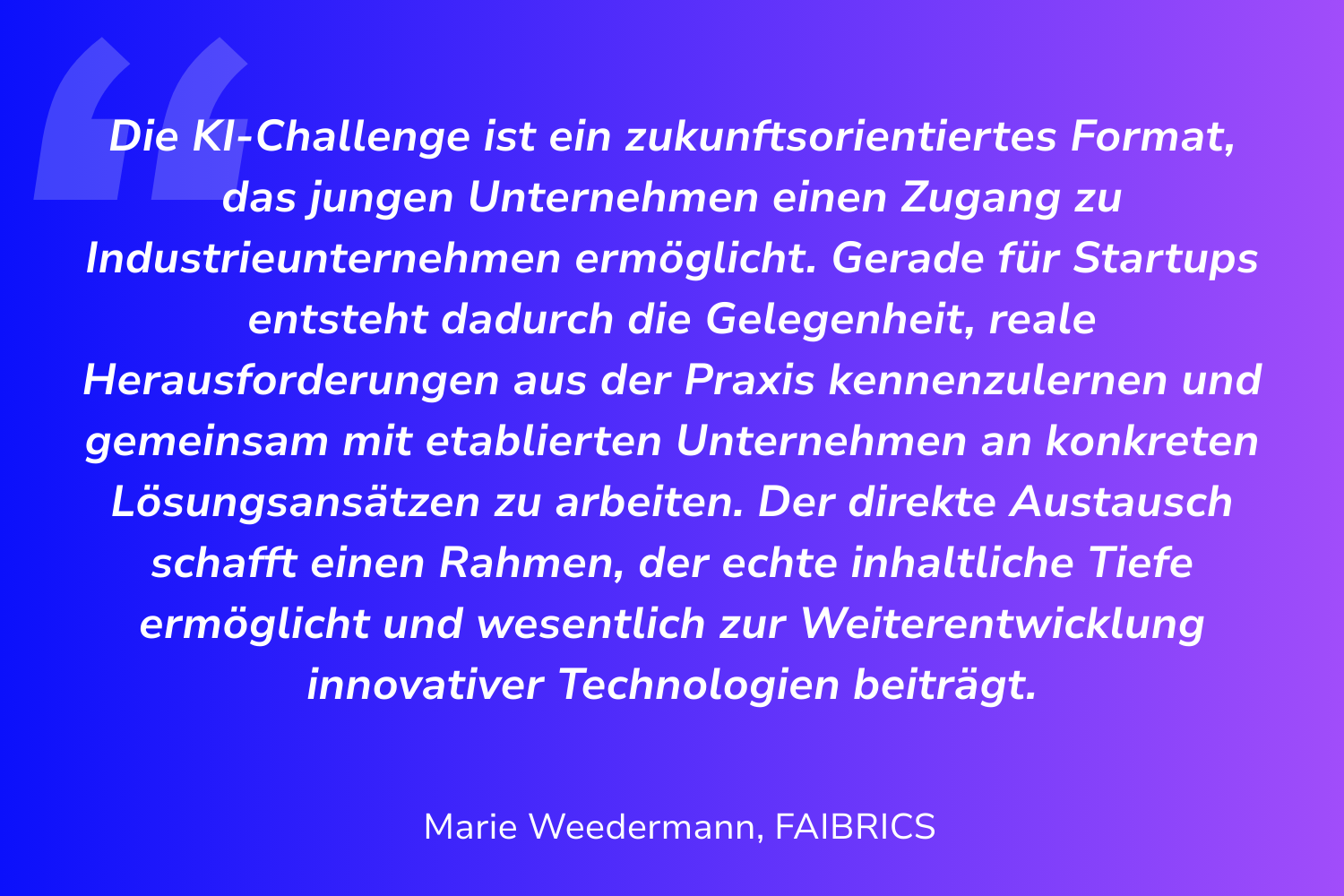
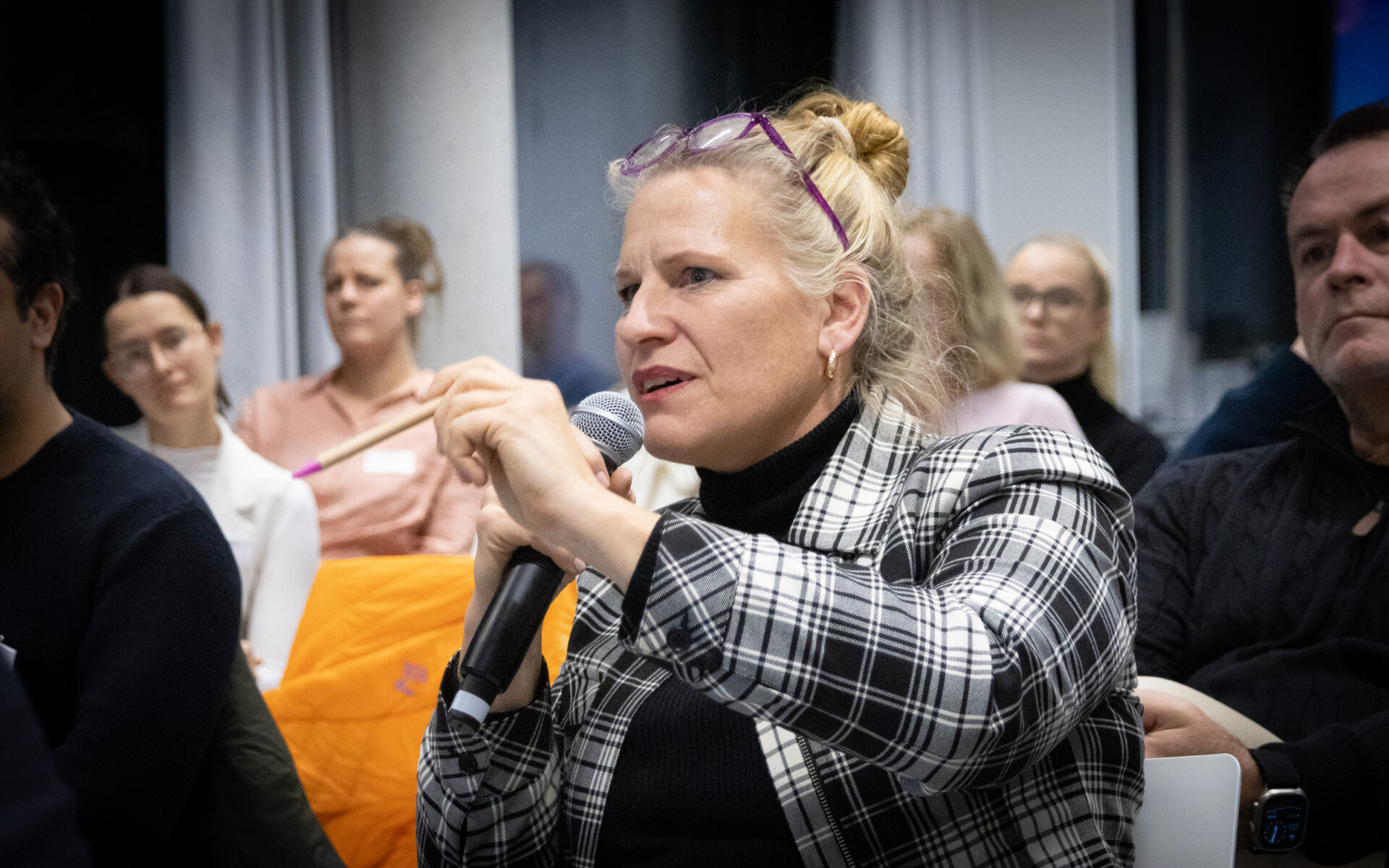

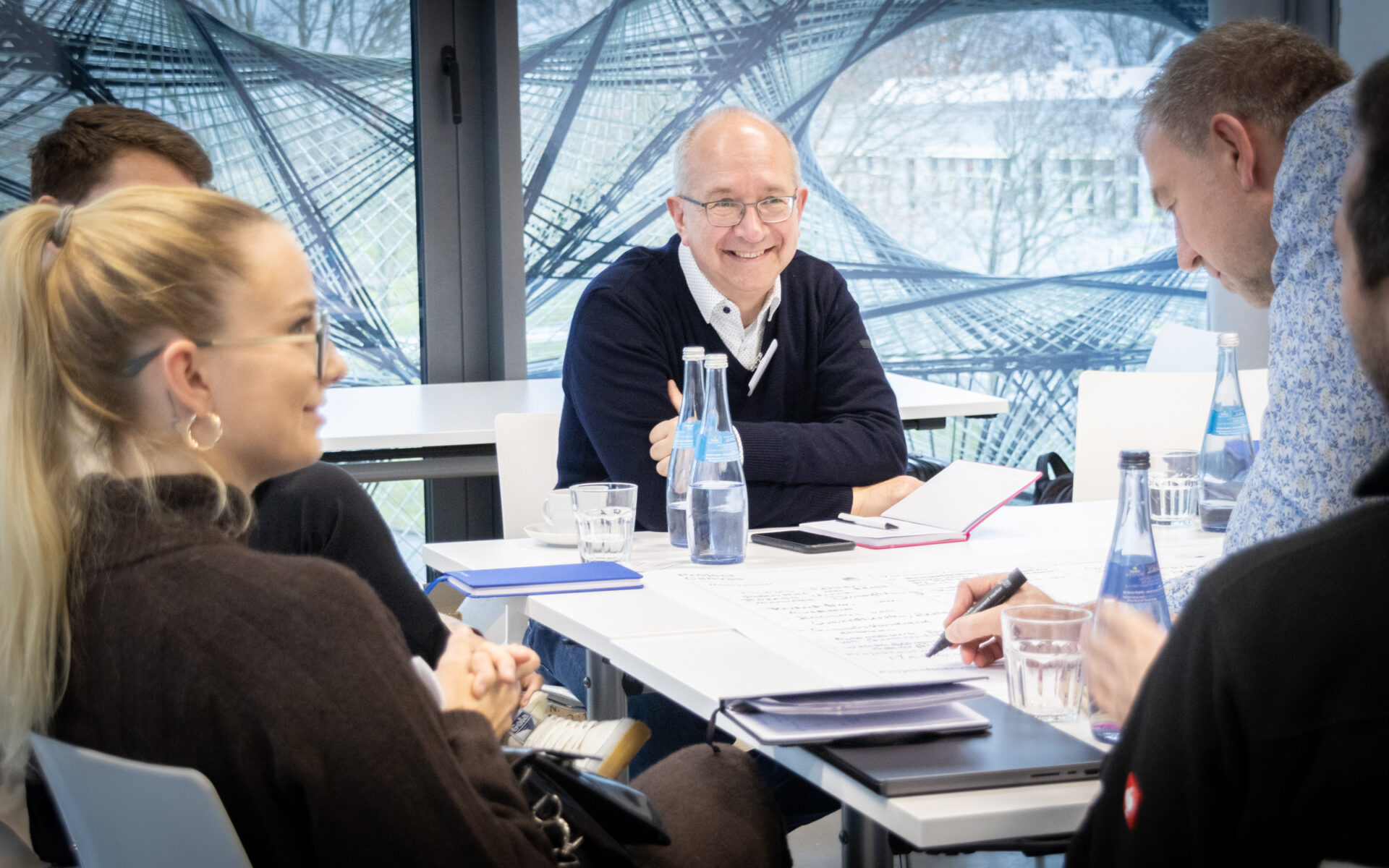
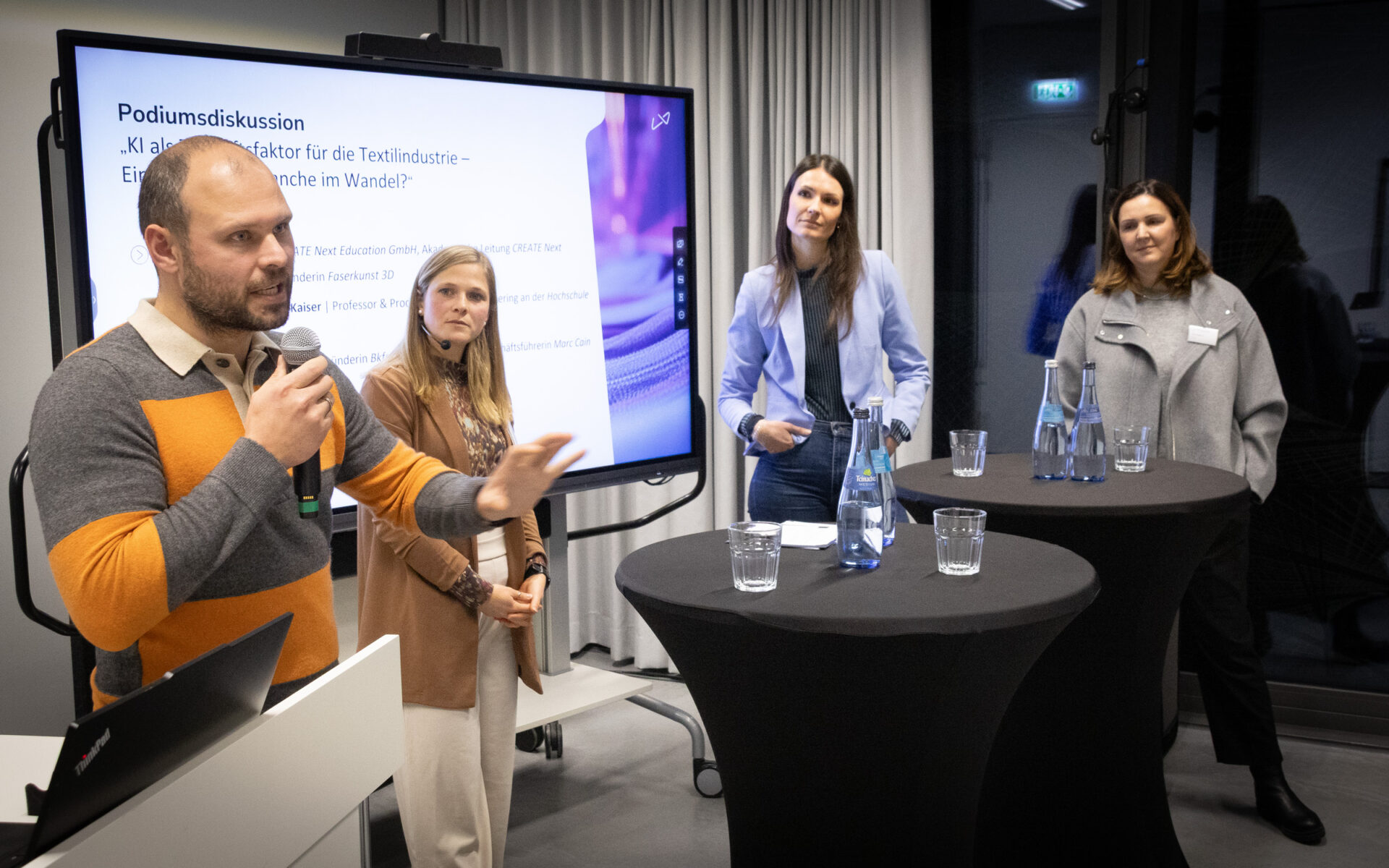
We are all dependent on each other.
Johannes Arnold Lord Mayor of the City of Ettlingen
The great thing about AI (artificial intelligence) is that I can bring many aspects together.
Dr. Frank Mentrup, Lord Mayor of the City of Karlsruhe
How can AI help us ask the right questions?
Markus Wiersch, Deputy Managing Director of Karlsruhe Marketing Event GmbH
What is special about this workshop format is that the providers do not develop solutions that can subsequently be offered to users, but that users themselves are directly involved in the design.
Thomas Usländer, project manager of the AI Challenge
Our plan worked. The participants were inspired by the kick-off event and there was a lack of time, not a lack of ideas.
Akiza Hagami, Community Manager of the Baden-Württemberg AI Alliance