Green AI: How the Stuttgart Region Is Tackling Climate Change with AI

Heat waves that get trapped in urban canyons. Heavy rains that overwhelm the sewer system. Land becoming scarce even as demand grows: Climate change in the Stuttgart region is no longer some abstract issue of the future, but a daily reality for municipalities, businesses, and residents. Reason enough for an AI challenge under the theme “Green AI – Life in the Age of Climate Change.”

Together with Fraunhofer IOSB and partners including the Baden-Württemberg Ministry of the Interior—Digitalization Strategy Division, the Stuttgart Region Association, the Stuttgart Region Economic Development Agency, the City of Stuttgart, and the City of Böblingen, the Stuttgart Region Community Management team of the Baden-Württemberg AI Alliance brought together users and AI experts. Following the kickoff event on July 7 at the Literaturhaus Stuttgart, participants worked on specific challenges the next day. Four project ideas emerged from four thematic areas that had been developed in advance with all partners.

The potential for this transformation lies right here on the ground—we just need to harness it, bring the right people together, and empower them to develop solutions collaboratively. For us, community management means building bridges: between innovation and application, between experts and newcomers, and between questions and concrete solutions.
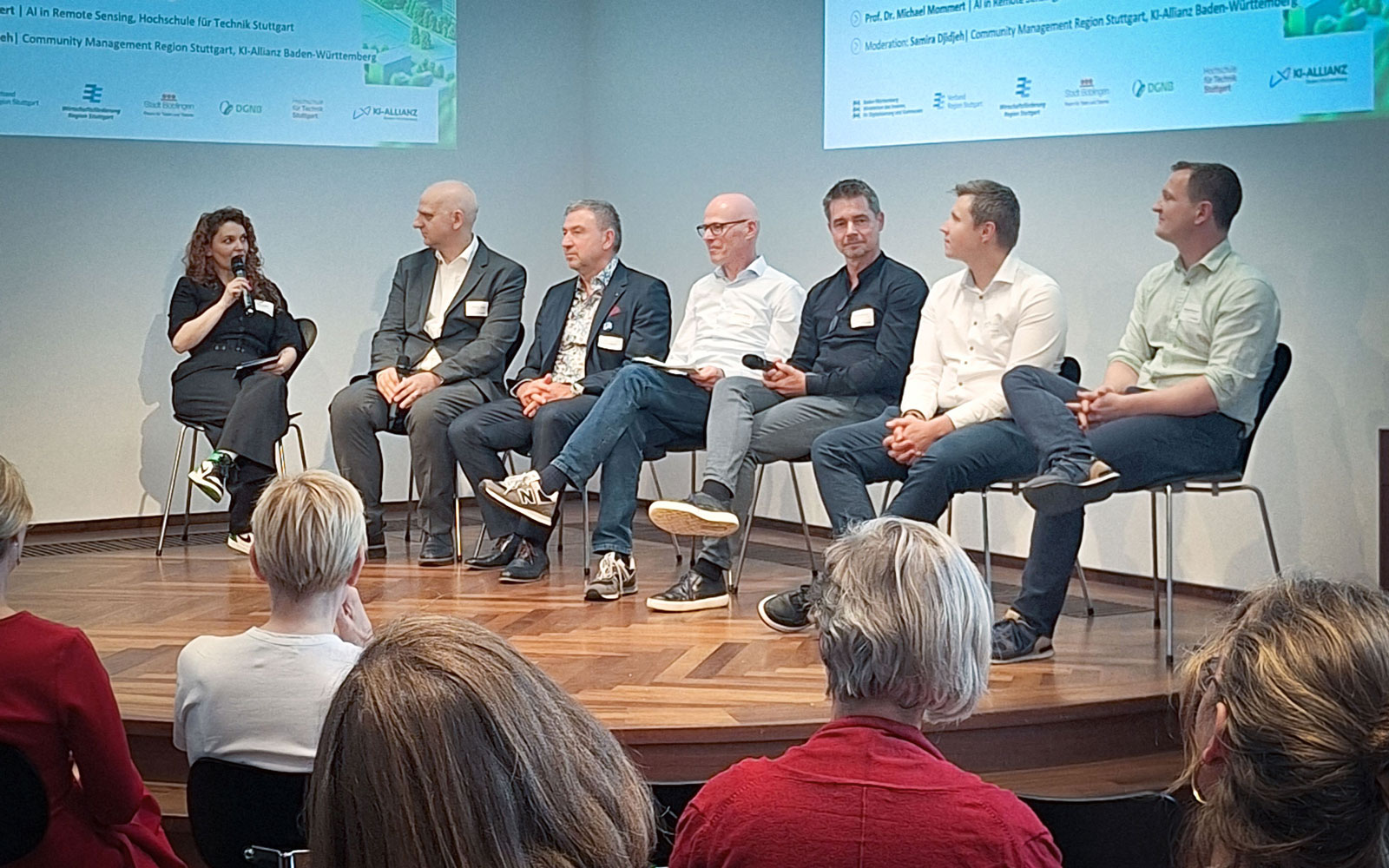
Kickoff of the AI Challenge in Stuttgart.

Climate adaptation becomes measurable

Where would an additional tree be most beneficial? How can we ensure that urban trees and plants are watered, and what other measures against heat are effective and actually feasible locally? The #BaumLuft project aims to answer these questions with the help of software. Among other things, it would combine map, temperature, civil engineering, and network data to visualize the potential impacts of planned measures. This would allow municipalities to compare locations and scenarios before making investments.

Sustainability as a Location Factor

Industrial parks must also adapt. In addition to economic development, issues such as energy, water, mobility, land use, and biodiversity play a role in their planning. This is where the N-GE Twin concept comes in: An AI-powered assistance system is designed to consolidate relevant knowledge and up-to-date data, complement existing planning software, and enable a comparison of different development scenarios. This could help municipalities and businesses plan sustainable industrial parks more effectively.

Industrial parks must be economically attractive while also becoming more sustainable. In an interview with SWR , Thomas Usländer made it clear just how closely these two issues are linked:

How can a location be made more attractive? How can energy costs be reduced? These are not only environmental considerations but also, quite clearly, economic ones.

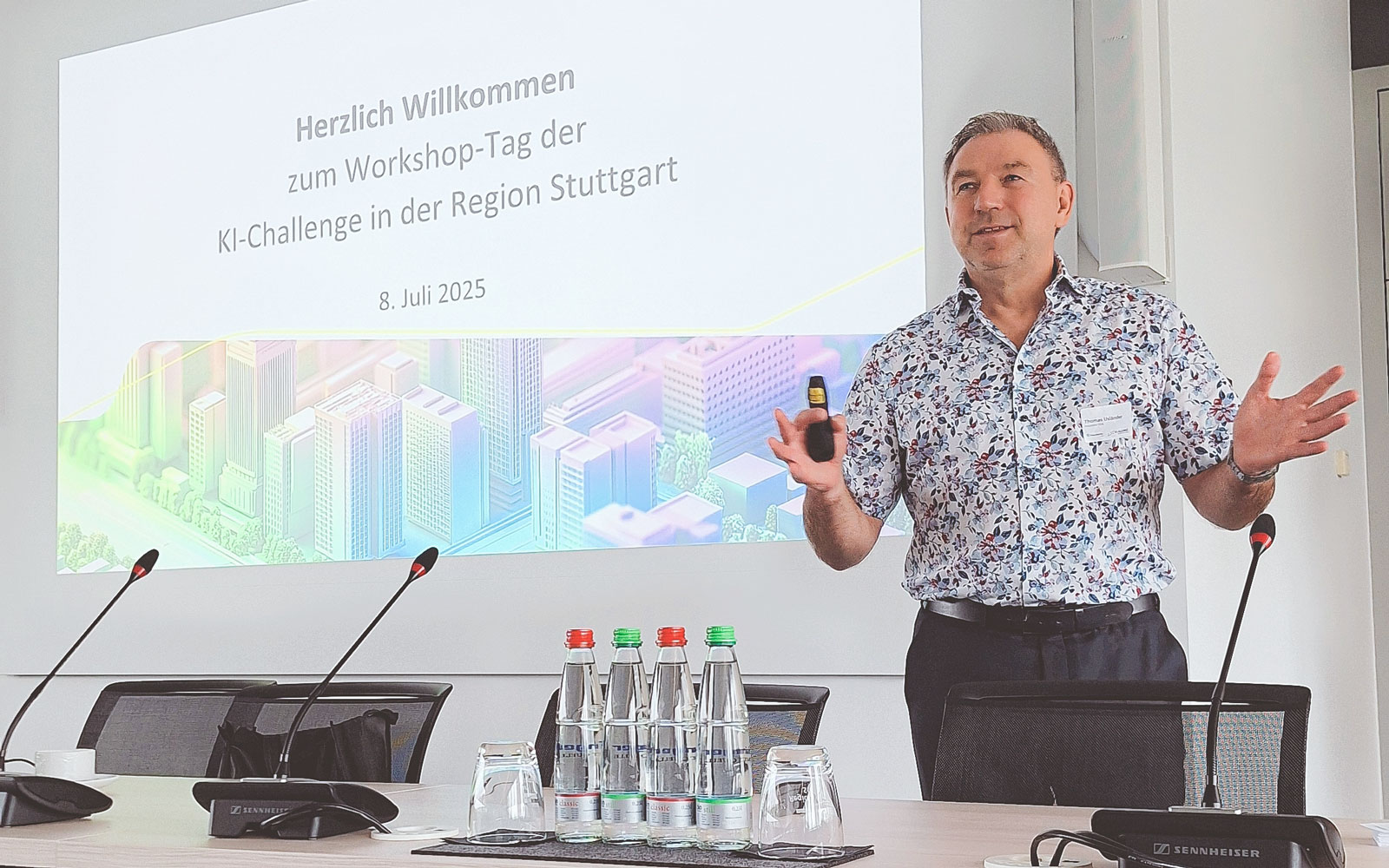
Dr.-Ing. Thomas Usländer opens the AI Challenge Stuttgart Region workshop.

Heat hotspots become visible

Anyone seeking to strategically increase green space or reduce impervious surfaces needs to know where the need is greatest. The UrbanMind project aims to analyze satellite, drone, and municipal geospatial data to map green spaces, impervious surfaces, and heat islands, and to translate the results into maps and recommendations for action. The goal is to create a foundation that can be integrated into municipal planning processes.

Planning Before Groundbreaking

Energy grids, generation facilities, and storage systems are planned for many years in advance. The E-Infra Planning project aims to consolidate data on generation, consumption, and grids and enable the evaluation of various expansion and retrofit scenarios using AI and a digital twin. This would allow municipalities, grid operators, and other stakeholders to identify the consequences of their plans earlier and make decisions based on a shared data foundation.

What Matters in the End

Four topics—and one common goal: to process data in a way that enables people to make better decisions about climate adaptation and infrastructure.
Four project ideas—and one common starting point: people with diverse experiences have tackled specific regional challenges. Samira Djidjeh from the Stuttgart region explains what motivates Community Management Region Stuttgart to undertake such projects:

AI-powered tools also enable municipalities to respond more quickly to extreme weather events and flexibly adapt their adaptation strategies. We therefore support the use of AI as a tool to enhance municipal climate resilience and achieve established climate goals, particularly in small and medium-sized municipalities that rely on limited resources.

#BaumLuft, N-GE Twin, UrbanMind, and E-Infra Planning are project ideas at this stage. Whether they will become concrete applications will be determined as the projects are further developed in collaboration with local partners.

Through the AI Challenge, the AI Alliance has brought together people and approaches based on real-world needs.

AI Challenge Partner Network Stuttgart Region

The AI Challenge of the KI-Allianz Baden-Württemberg is organized in the Stuttgart region by the Community Management of the KI-Allianz Baden-Württemberg and the Fraunhofer IOSB in close cooperation with our regional network partners.

Together, we are advancing our region with sustainable AI solutions and strengthening the regional AI ecosystem. Seize this opportunity and join us. Become part of our community!

The AI Challenge is sponsored by:

Discover more articles

AI Consulting, AI Infrastructure, AI Solutions, AI Training: Members of the Baden-Württemberg AI Alliance share AI services at a discount or even for free within the network.

Interview with Leon Rocca (AlgebraX): Why AI projects in small and medium-sized businesses fail, where time goes, and when employees adopt a solution.