

Today, hardly any medium-sized company fundamentally questions whether artificial intelligence can be relevant. The crucial question is a different one: Where to start? Amid grand promises, new tools, regulatory requirements, and limited resources, getting started is often difficult. It is precisely at this point that it is determined whether an idea will become a viable project—or whether it will remain stuck in day-to-day operations.
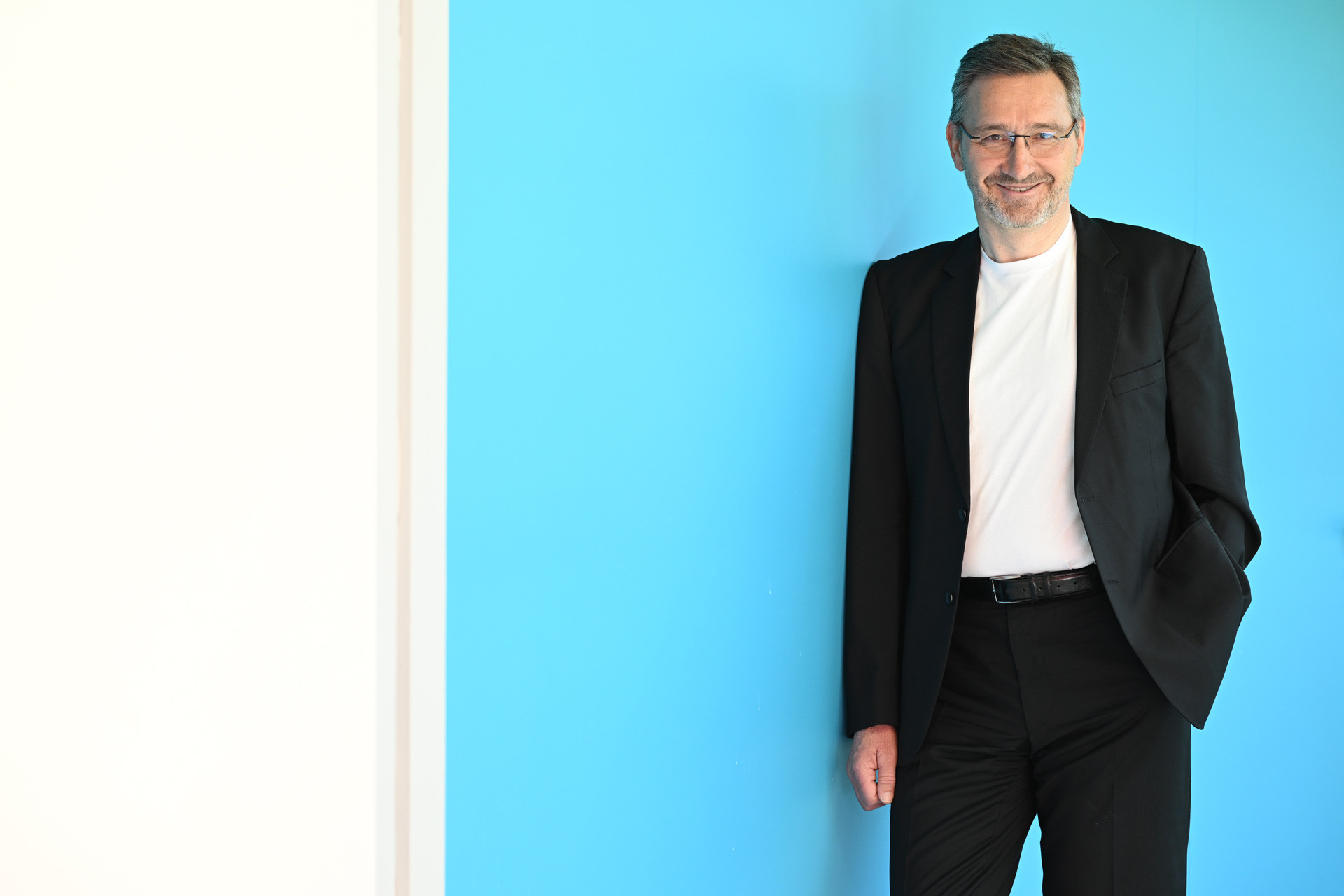
Dr. Andreas Wierse heads SICOS BW GmbH in Stuttgart—and knows from personal experience what it’s like to steer a company with limited resources through uncharted technological territory. For fourteen years, he himself served as managing director of a small company that he had built up together with a partner from a spin-off of the University of Stuttgart. When the dot-com bubble burst, he was hit hard: bankruptcy, having just moved into a new home, and a four-year-old son. “That’s why I know so well what it’s like on the other side,” he says today.
When Michael Resch from the HLRS asked him if he knew anyone who could serve as a bridge between research and small and medium-sized businesses, Wierse took the Christmas holidays to think it over—and then realized that he was the one they had in mind. He’s been doing this work for 15 years. And not a single day goes by when he gets bored.
A Bridge Between Research and Small and Medium-Sized Businesses
SICOS BW was founded in 2011 by the Karlsruhe Institute of Technology and the University of Stuttgart. Its goal was—and remains—to make it easier for small and medium-sized enterprises to access simulation, high-performance computing, data analytics, and AI. Its role is intentionally different from that of a traditional consulting firm: SICOS BW does not develop off-the-shelf AI products, does not sell its own software, and does not handle implementation in the strict sense of the term.
Wierse describes the task as follows: “We’re like trend scouts. We go out and look for companies that might need one of the innovative technologies our research partners are working on. Then we connect them with research partners, such as KIT or the University of Stuttgart.”
Why SMEs Need Guidance
For Wierse, the central challenge for small and medium-sized businesses lies less in a lack of interest than in the broader context. Limited time, scarce resources, and often a lack of expertise make it difficult to get started. This is not meant to be a criticism, but rather a description of a structural reality. Small and medium-sized businesses typically do not have their own AI departments, internal data science teams, or large innovation budgets. They must evaluate new technologies within the context of their day-to-day operations. That’s why they need impartial guidance: an initial consultation without sales pressure, a realistic assessment of the potential, and an evaluation of whether AI, data analytics, or simulation are even the right approach for the specific problem at hand. For SMEs in Baden-Württemberg, this support from SICOS BW is provided free of charge.
Before the algorithm comes the question of data
The journey into AI rarely begins with the tool. Often, a much more fundamental question comes first. Wierse recalls that this question has been with him for many years—even decades: “What data should I collect? That’s actually still a relevant question.” And also: What data is generated in the course of business anyway? Which data is stored, and which is lost? Which processes generate information from which patterns can be derived? Anyone who skips this step runs the risk of investing in technology before the actual problem has been understood. That’s why SICOS BW gets involved early on: In potential analyses, we work with companies to determine where data-driven methods, simulation, or AI can be usefully applied.
Act as a neutral intermediary rather than selling on your own
A key difference from commercial offerings lies in positioning. SICOS BW explicitly does not see itself as competition to service providers—quite the contrary. If a market-ready solution already exists for a problem, referring the client to that solution is often the right step. SICOS BW becomes particularly valuable when an issue is still in its innovative phase, when research can help, or when a company cannot make progress on its own. This is where the expertise of SICOS’s partners—KIT and the University of Stuttgart—comes into play.
Wierse puts it this way: “If it’s easy, we’re out. Then there are others who can implement it better and on a sustainable basis.” This logic also helps prevent conflicts of interest: Once something is commercially established, it no longer needs publicly funded support.
AI is effective when it solves specific problems
Real-world examples illustrate just how tangible the benefits can be. In the case of hydrograv, the focus was on optimizing wastewater treatment plants: Through simulation and AI-supported control, existing plants can be improved in such a way that costly new construction is not always necessary. Another example is Kärcher, where researchers investigated whether cleaning nozzles could be further optimized using AI methods. If a nozzle requires less water and energy while maintaining the same performance—and the product is sold in large quantities—this creates significant economic and environmental benefits. Wierse sums it up: “That saves a massive amount of resources—and that’s when AI is clearly worth it.”
The greatest value rarely comes from the most buzzword-heavy areas. It arises when a real problem is thoroughly understood, linked to the right data, and addressed with the appropriate expertise.
The first step doesn't have to be a big one—but it should be purposeful
For companies, there are three key takeaways: Before embarking on any AI project, the first question to ask is about your own data—not about the latest tool. Guidance and implementation are distinct roles. And most importantly: In Baden-Württemberg, there are neutral resources that help companies take their first steps without any commercial agenda.
About Dr. Andreas Wierse
Dr. Andreas Wierse has been the managing director of SICOS BW GmbH in Stuttgart since its founding in 2011. The company was founded by the Karlsruhe Institute of Technology and the University of Stuttgart to serve as a bridge between cutting-edge research and small and medium-sized enterprises (SMEs), and it provides neutral, independent, and free consulting to SMEs on getting started with high-performance computing, simulation, data analysis, and artificial intelligence. Over the past 15 years, this has resulted in more than 150 projects and initiatives. Since 2014, Wierse has also led hww GmbH, a public-private partnership in high-performance computing with the State of Baden-Württemberg, KIT, Porsche, T-Systems, and the University of Stuttgart as shareholders. A mathematician with a Ph.D., he has been working on visualization and virtual reality since the 1990s, most recently as co-founder and managing director of Visenso GmbH, and is co-author of the “Smart Data Analytics Practical Handbook.”
Dr. Andreas Wierse has been a member of the Supervisory Board of KI-Allianz Baden-Württemberg eG since June 2026.