

Artificial intelligence is the key technology of our time—we at the Baden-Württemberg AI Alliance are convinced of this. But how can we ensure that not just a few pioneers, but the entire spectrum of our economy benefits from it?
The following guest article by Dr. Christoph Ziegler addresses this question.
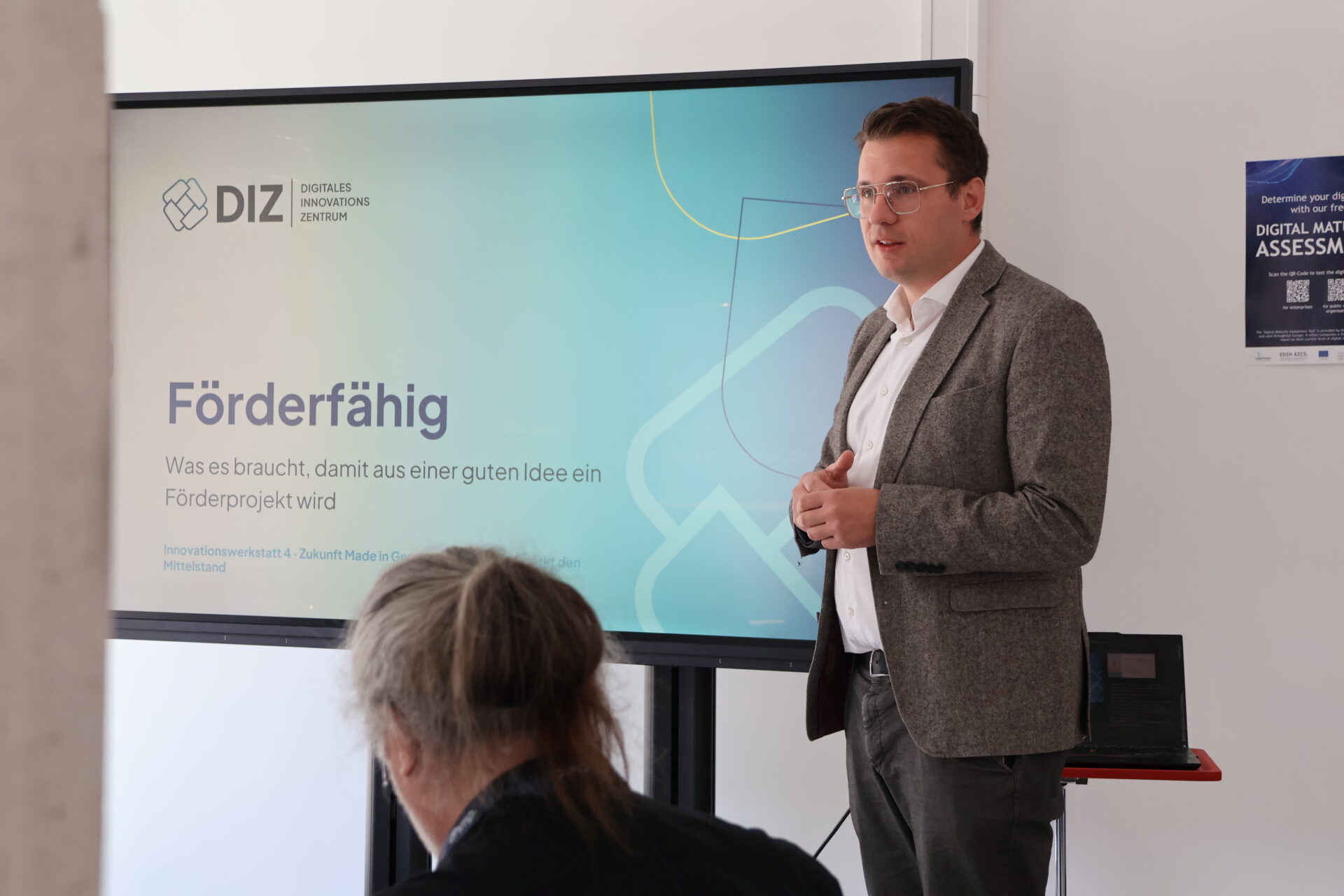
Dr. Christoph Ziegler spent more than seven years evaluating funding projects at the Project Management Agency Karlsruhe (PBK) and now heads the Innovation Policy and R&D Funding Advisory Division at the DIZ | Digital Innovation Center in Karlsruhe. In this guest article, he will explain what we can learn from the Industrial Revolution and why the most important AI investment is often not software, but a new partner.
AI is the key technology of our time
AI will transform the way we work, conduct research, and do business—probably as fundamentally as the steam engine once did. That is precisely why it is worth taking a look back. During the Industrial Revolution, Great Britain became increasingly productive over the course of decades, but for a long time, surprisingly little of that progress reached the people. Economists refer to this as the “Engels’ Pause”: the gap between technological breakthroughs and widespread benefits.
In the decades that followed, however, wages rose even faster than productivity. Not because technology had changed, but because people took action: through labor protection laws, through unions, and above all through education. In England alone, hundreds of night schools for skilled workers sprang up—organized locally rather than mandated from above. This sends an encouraging message: We ourselves decide what impact a technology will have.
AI is the future—and how good it will be for all of us is entirely up to us.
Dr. Christoph Ziegler, Head of Innovation Policy and R&D Funding Consulting, DIZ | Digital Innovation Center
AI – The Current State of Affairs
The potential is enormous. According to a recent PwC study, the most successful companies—those heavily reliant on AI—have more than doubled their revenue per employee since 2018, and wages there are also rising significantly. AI, then, makes work more valuable. At the same time, we’re seeing a gap emerge once again: the top performers are pulling ahead of the average. The question, then, is less whether AI works and more who benefits from it.
The Situation in Baden-Württemberg
The conditions are excellent. Nearly half of all “hidden champions” worldwide are based in Germany—highly specialized global market leaders that hardly anyone knows about. Their recipe for success is continuity: Those who lead such companies often do so for about two decades, and they know their customers and niche better than anyone else. In times of upheaval, however, this very consistency can also act as a brake. Those who have been successful for a long time tend to stick to what has been tried and true.
The biggest challenge
Competition is getting tougher. China is now specifically supporting more than 10,000 specialized companies designed to challenge us precisely in the niches where we still lead today. Those who simply carry on as before will lose ground. The good news is that with AI, we have a tool at our disposal to reestablish our lead.
The true capital of small and medium-sized businesses is their knowledge and data: decades of experience with machinery, materials, processes, and customers—often stored in the minds of long-time employees. AI can preserve this knowledge and data, make it usable, and scale it—for example, as a digital assistant in customer service or as a new data-driven offering. This represents a huge opportunity, especially since many experienced specialists will be retiring in the coming years.
Not to be underestimated
AI is changing tasks and roles, and that creates uncertainty. Companies that involve and train their employees early on turn those affected into active participants—just as evening schools did back then. There are also very practical questions: How good is my data? Where do I let a system make decisions, and where don’t I? These questions should be asked openly. But they’re not a reason to wait—they’re a reason to start now.
However, simply purchasing tools is rarely enough. Most medium-sized companies do not have the necessary expertise in-house—ranging from data architecture and model development to agile product development. The most important AI investment is therefore often not software, but a new partner.
The Solution: Partnerships
A great example of partnerships is the collaboration between NEURA Robotics from Metzingen and Schaeffler. NEURA brings cognitive robotics and humanoid robots to the table, while Schaeffler brings something no investor in the world can buy: decades of experience in precision manufacturing and industrial scaling. Schaeffler supplies key components and plans to use the humanoids in its own production in the future. This is not a traditional supplier relationship, but rather a symbiotic partnership: each brings what the other lacks—and both grow as a result.
The most important AI investment is often not software, but a new partner.
Dr. Christoph Ziegler, Head of Innovation Policy and R&D Funding Consulting, DIZ | Digital Innovation Center
This approach also works for smaller companies: In the ZIM innovation network “AI in Technical Service”—KIsS for short—which we launched at the DIZ, more than twenty partners are now collaborating on AI solutions for maintenance and repair. Startups like SquareNeo Solutions contribute AI software, the Fraunhofer IAO provides the scientific foundation, and industrial companies like RATIONAL bring practical experience and market access. On their own, each of these partners would be insufficient. Together, they create solutions that are tested under real-world conditions rather than remaining mere concepts on slides.
At the same time, very different worlds come together here. Small and medium-sized enterprises think in terms of reliability and generations; startups think in terms of sprints and funding rounds; and researchers think in terms of methods and publications. Without someone to bridge the gap, collaborations often remain superficial. We need bridge-builders who can highlight interests, create suitable frameworks, and build trust. This work is often underestimated because it doesn’t generate patents or revenue, but rather relationships—and in the end, it is precisely these relationships that determine success.
Startups, in particular, often bring the latest AI solutions to the table, but unfortunately don’t always get their fair share of funding. I’ve seen many great ideas from startups that fell through because of a technicality: Traditional funding programs require a high level of personal investment, and creditworthiness is checked in advance. Young companies that aren’t yet turning a profit quickly fall through the cracks. Yet the company’s own contribution doesn’t necessarily have to come from its own coffers—binding commitments from investors can cover it. I’d like to see more courage in taking advantage of the available leeway here.
Are you still looking for a clear and easy-to-understand introduction to the topic of grants—perhaps because you’re already planning an AI project and the funding is still unclear?
Then join us for our AI Funding Webinar on November 2 from 1:00 p.m. to 3:00 p.m.
By the end, you'll walk away not only with knowledge, but also with concrete next steps for financing your own AI project.
The next break: Six years or six decades?
Unlike in the 19th century, we recognize this pattern today, and with vocational training, employee participation, and strong regional networks, we have much better conditions. Decisions are not made in data centers, but in companies, universities, government agencies, and networks. The evening schools of the past were organized locally. Their modern counterparts are regional and resilient ecosystems—such as the Baden-Württemberg AI Alliance—where small and medium-sized businesses, startups, and academia come together. AI is the future—and how good it will be for all of us is entirely up to us. We know the script. We’re writing the second act ourselves.