From Concept to Implementation: What Makes AI Projects Viable for Small and Medium-Sized Businesses
Tobias Kenner
Published on:
Hardly anyone questions today whether AI is relevant for small and medium-sized businesses. Its strategic importance is widely recognized, initial tools are being tested, and at the same time, requirements are increasing—for example, due to the EU AI Act. It remains to be seen how this interest will translate into practical applications that are used in everyday business. Between the workshop, the first tool, and productive deployment, there are several key decisions to be made: Which idea will be pursued? Who will champion it within the company? And where can an external partner help? These decisions often determine success more than the technology itself.
The CyberForum’sAI Innovation Lab, a member of the Baden-Württemberg AI Alliance, explores these questions in six articles. They cover the selection of use cases, building expertise within the company, collaboration with startups, and two practical applications. The answers vary depending on the company, but the underlying patterns are similar: expertise is not developed through a one-time training session, but rather in relation to the tasks of the individual departments. Startups are helpful when it is clear what problem they are supposed to solve. And AI assistance is accepted when the people working with it retain decision-making authority. All six articles are based on a specific task within the company.
Many ideas, targeted implementation: Following the initial AI workshops, the focus is now on selecting the right approaches and pursuing them consistently.
Needs as a Starting Point
Ideas are usually plentiful in companies. What’s often in short supply, however, is the time, resources, and perspective needed to evaluate them. In this article on introducing AI in small and medium-sized businesses therefore addresses the question of how to turn many ideas into an initial use case that the company can actually support. The article illustrates this point by drawing a contrast: A new data-driven business model or a company-wide platform is strategically appealing but ties up resources for months. A more suitable first step is a task where inefficiencies or errors in day-to-day operations are well-known and can be tackled in a manageable way. Sometimes, a clearer process structure or more modern software can solve the problem without the need for in-house AI development at all.
The initial need shapes everything that follows: the skills a team needs, the right partners, and the solution that will be used in day-to-day operations. For that solution to be used, the people in the company must be on board.
Build Skills, Engage Employees
In the article on corporate AI training focuses on building competencies on two levels: a shared basic understanding for everyone, and—building on that—formats tailored to the tasks of individual departments. The framework is also part of this—that is, access to tools and clarity on how to use them. As an example, the article describes a medium-sized industrial company that, starting with the desire for a single training session, developed a tiered approach: a foundation for all employees, a separate program for managers, and in-depth training for departments such as marketing and sales, development, or IT.
Training and real-world applications go hand in hand: Without specific tasks, training remains theoretical, and without the necessary skills, a real-world application goes unused.
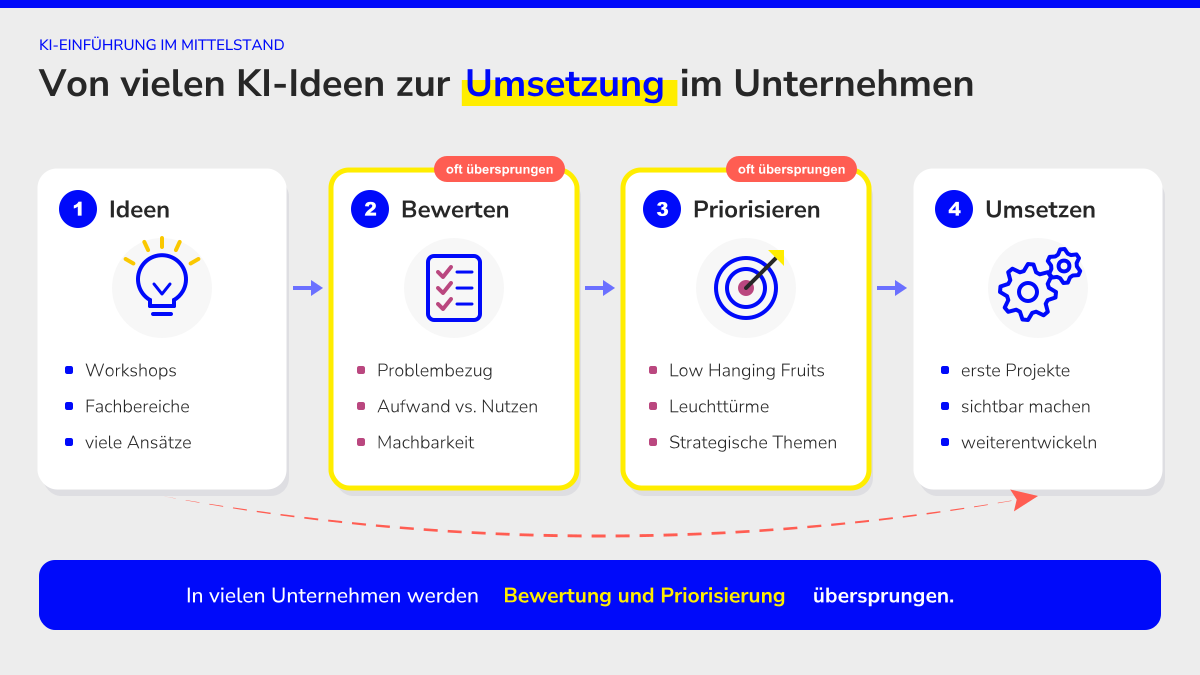
From an AI idea pool to implementation: the four steps—ideas, evaluation, prioritization, and implementation.
Start-ups as External Partners
However, a company does not have to implement every use case on its own. Nor does it have to develop every solution on its own. Where internal capacity is lacking, startups can contribute external innovative capabilities. This article explains how that worksStartup Collaborations in Small and Medium-Sized Enterprises. Such collaborations, however, should arise from a specific need within the business unit and not from the ideas of individual startups.
The article provides practical examples of thisStartup Collaborations in the Energy Sector. It describes how Stadtwerke Karlsruhe, through its innovation subsidiary SWK Novatec, brings together specialized departments and startups—for example, in the introduction of dynamic electricity rates. In this way, specific needs serve as the catalyst for the collaboration.
Two Real-World Use Cases
Two cases illustrate how this plays out in practice. Both are from the KARL Competence Center research project, in which the CyberForum participates as a consortium partner.
In the BLANC & FISCHER case study focuses on workforce scheduling in manufacturing. Until now, managers have primarily relied on experience to plan staffing per shift, and last-minute operational changes require constant adjustments. An AI assistant is designed to make recommendations based on historical data, while managers retain the final decision-making authority. At the same time, the goal is to make the planning process more transparent for employees.
In the Karlsruhe Transport Association (KVV) case study , on the other hand, focuses on managing a control center during service disruptions. When a disruption occurs, dispatchers must quickly weigh many factors and initiate measures such as rerouting or turning buses around. A recommendation assistant, trained on historical operational data, is designed to support them in this process.
Both case studies follow a similar logic: The starting point is a specific problem that is evident in day-to-day work. Based on historical data, assistance systems are developed that provide suggestions, while the decision-making authority remains with the employees. In the area of production planning, a pilot program is planned for implementation at the plant. The control center is currently in the prototype development phase.
An AI assistant is designed to help public transit control centers quickly determine the appropriate course of action in the event of disruptions.
What Companies Can Take Away From This
The difference between an idea that fizzles out and a use case that actually makes an impact therefore rarely lies in the technology. It lies in the willingness to analyze problems thoroughly, to start small and in a testable way, and to realistically assess one’s own capabilities. This is precisely what strengthens a company’s ability to act and lays the foundation for AI to move beyond individual projects and become widely adopted.