

Many companies are currently facing a similar situation: they recognize the strategic importance of artificial intelligence, are testing initial tools such as ChatGPT or Microsoft Copilot, and at the same time are facing increasing regulatory requirements stemming from initiatives like the EU AI Act.
And yet one key question often remains unanswered:
How can companies approach this topic in a meaningful and structured way? AI training for employees is often the first step. In practice, however, it quickly becomes clear that this alone is not enough.
Why a one-time AI training session at a company is rarely enough
Many organizations start with a basic introduction to the topic of AI. While this provides some guidance, it rarely leads to actual implementation.
What is often missing:
- the connection to one's own daily work routine
- specific use cases
- a clear next step after the training
AI is changing the way we work. And that is precisely why it takes more than a one-time push.
How Companies Are Building AI Capabilities in Practice
In many companies, the initial question is often which AI training program would be most appropriate. In practice, however, it quickly becomes clear that the focus is less on a single training format and more on the structured development of skills.
An approach that has proven effective combines two levels: a common foundation for all employees and targeted specialization within the various departments.
AI literacy as a common foundation
The first step is to establish a shared basic understanding within the company. This is less about technical depth and more about getting a sense of the big picture: What can AI do today, what are its limitations, which tools are relevant, and what does this mean specifically for our company?
Equally important is the organizational framework, for example when it comes to handling data or using tools. Especially in the context of data protection and regulatory requirements, this provides a sense of security in day-to-day operations.
Empower departments with practical training formats
The real added value comes when AI is applied in a specific work context. That is why it is worthwhile to tailor training programs specifically to individual departments, their typical tasks, and relevant use cases. The focus here is on how AI tools that have already been approved or can be implemented in the short term can be used effectively in day-to-day work—for example, for research, text editing, accessing knowledge, preparing for meetings, or automating repetitive tasks.
This is precisely where many companies find a major opportunity: not in abstract AI possibilities, but in applications that teams can quickly integrate into their daily work using the resources they already have. This leads to practical training formats that address employees’ specific tasks and demonstrate how AI can be effectively applied in their respective areas—based on existing tools, concrete use cases, and the company’s actual work processes.
Enablement as a Prerequisite: AI Skills Need the Right Framework
For such department-specific training to be effective, the right conditions must be in place within the company. Above all, this means that employees must have access to appropriate tools and a clear understanding of how to use them. At the same time, experience shows that not all use cases can be addressed with a single tool or a generic approach.
For this reason, the development of AI skills should always be viewed within the context of the company’s broader AI initiatives. This includes taking a structured approach to relevant use cases, suitable tools, and meaningful integration into existing processes. Only through this combination of training, concrete applications, and appropriate framework conditions can an approach be developed that truly works in day-to-day operations.
Conclusion: AI training is a starting point, but not the end goal
Providing AI training within a company is a sensible first step. However, what matters most is what comes of it.
The real added value emerges when employees begin to use AI in their day-to-day work and develop new ways of working. For many companies, this is precisely where the greatest opportunity currently lies.
Case Study: How a Mid-Sized Company Structured Its AI Training Program
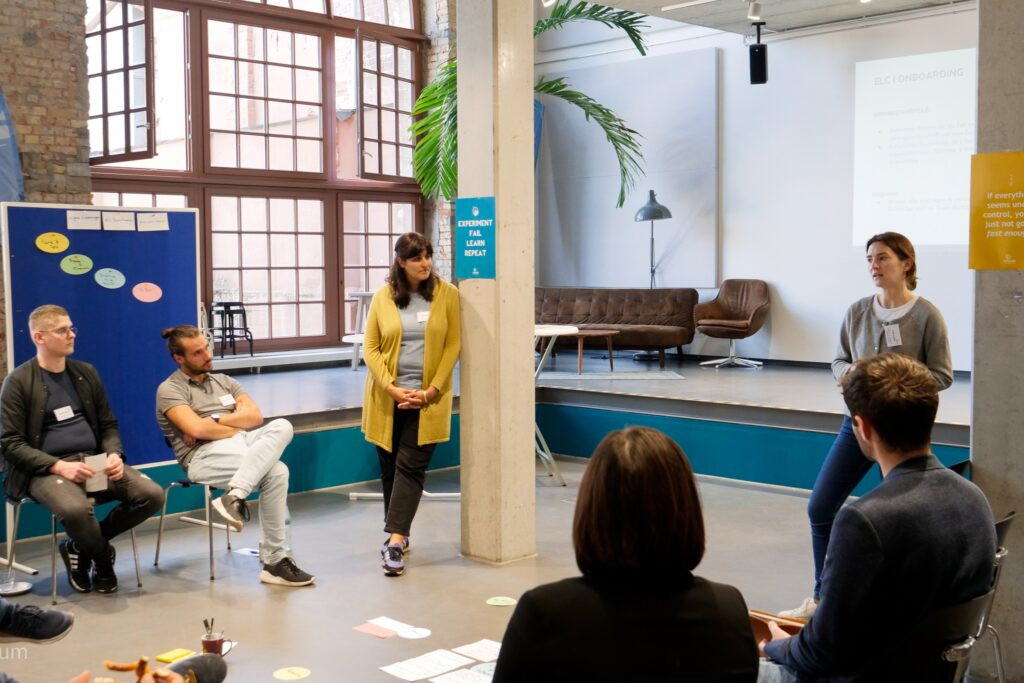
A medium-sized industrial company wanted to take a systematic approach to building AI expertise. Instead of simply offering general training, it developed a tiered training program designed to specifically address different target groups.
The initiative began with a basic training session for all employees. The session focused on developing a shared understanding of AI, the safe use of approved tools, data protection issues, and initial practical applications in day-to-day work. This format was supplemented by short refresher sessions, such as learning lunches or concise practical workshops.
At the same time, selected target groups received in-depth training. For managers, the focus was on how AI affects processes, roles, and responsibilities, and what conditions need to be established to enable teams to work effectively with AI. Building on this, specific training programs were implemented in the various departments—for example, for marketing and sales on using AI for content, research, and efficiency gains in daily work; for innovation and development teams on rapid prototyping and vibe coding; and for IT and development teams on the use of AI tools in development, documentation, and testing.
Thus, what began as a desire for “AI training” evolved into a training program that effectively addressed the needs of various target groups and enabled practical application in their daily work.
Are you tasked with building AI capabilities within your company?
The AI Innovation Lab at CyberForum helps companies take a structured approach to building these very skills—from foundational courses and sector-specific training to determining the framework and tools needed for implementation within the company.

Isabel Ernst: Let’s work together to figure out what a suitable AI training program for your company might look like.
- Project management AI Innovation Lab
- isabel.ernst@cyberforum.de
- 0721 602 897-717