

German industrial companies are currently engaged in a lot of brainstorming: workshops, AI task forces, and strategy sessions are generating a wealth of ideas ranging from automation in production and new data-driven services to support in sales and development. The mood is positive, and the new possibilities seem within reach.
And then? The ideas end up on a list. Individual topics may be raised, but after a few weeks, it’s unclear what actually came of them. Employees who contributed lose motivation, those responsible for AI are faced with a growing number of initiatives that are difficult to organize, and at the management level, the question increasingly arises: What concrete benefits does this actually bring us?
The challenge, then, rarely lies in coming up with ideas, but rather in selecting the right ones and turning them into reality.
Why Companies Fail with AI Use Cases in the SME Sector
If you take a closer look at medium-sized industrial companies, you’ll rarely find a lack of ideas. On the contrary: especially in areas such as production, quality management, development, or sales, concrete solutions emerge very quickly as soon as employees are involved. What happens next is crucial, and this is often where things get stuck.
People are thinking too big and starting out too complexly
Many companies jump right into topics that are strategically compelling but very time-consuming to implement:
- new data-driven business models
- Complex automation across multiple systems
- enterprise-wide platform solutions
The problem is that these issues require time, resources, and often external support as well.
In small and medium-sized businesses in particular, this quickly leads to projects dragging on, a lack of internal capacity, and a delay in seeing initial results.
Use cases often fail to address the actual problems
Another common mistake is that use cases are identified based on technological possibilities rather than on specific opportunities or challenges. The question then becomes not “Where do we have a real problem?” but “What can AI do?” This leads to the development of solutions that, while interesting, are rarely used in day-to-day work.
The effort involved and internal capabilities for AI use cases are often misjudged
Many companies underestimate what it takes not only to implement a use case but also to maintain it over the long term.
Crucial questions are often asked too late:
- Do we have the necessary internal resources?
- Do we have the right skills?
- Can we explore this topic further on our own later?
The result: Projects get off the ground, but are halted after a short time or get bogged down.
There is a lack of a clear approach to ideas regarding AI use cases within the company
In many cases, ideas are already being gathered through a bottom-up approach, and the departments often come up with very good ideas. What is often missing, however, is a structured process:
- How are these ideas evaluated?
- Which ones are prioritized?
- And what exactly happens next?
Without this structure, many tasks remain fragmented, and employees quickly lose motivation.
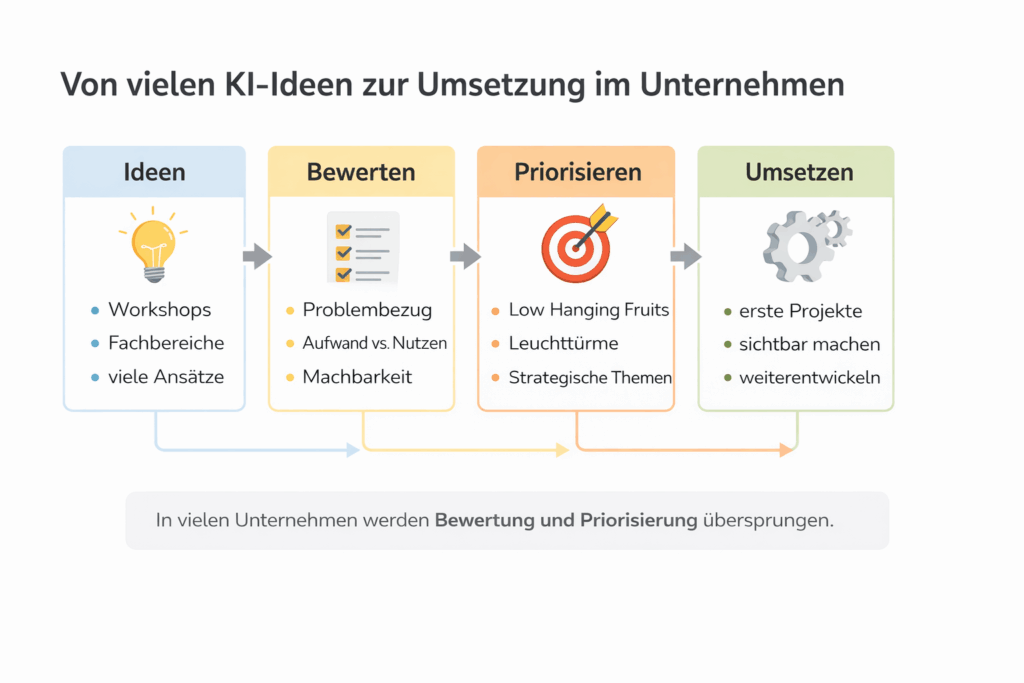
How to Choose the Right AI Use Cases for Small and Medium-Sized Businesses
The key step is to narrow down the many ideas to a meaningful selection.
Start with real-world problems, not with technology
The best use cases emerge where there are specific challenges.
- Where do friction losses occur?
- Which tasks are time-consuming or prone to errors?
- In what specific areas do employees need support?
This is a major advantage, especially for medium-sized industrial companies: the problems are well-known; they just need to be systematically identified and assessed.
Start small on purpose and make your initial successes visible
Especially in the beginning, the goal isn't to find the perfect use case, but rather to implement initial projects that:
- are manageable
- take effect quickly
- become visible within the company
Such a "breakthrough moment" is often crucial for gaining momentum within the company. In addition, these initial projects provide valuable learning opportunities and lay the groundwork for future strategic initiatives.
Distinguish between quick wins and strategic issues
A sensible approach combines:
- Low-hanging fruit: easy to implement
- Flagship projects: visible and inspiring
- Strategic issues: relevant in the long term
It is important to keep these separate and not try to tackle everything at once.
Be honest about what is feasible internally
Not every use case needs to be implemented externally, but not every use case can be meaningfully implemented internally either.
- What can we do ourselves?
- Where do we need help?
- What can we sustain in the long term?
This clarity prevents projects from being overambitious or failing later on.
Don't try to address every need with a custom AI solution
It’s important to note that not every problem can be effectively solved simply by “applying AI” to it. When processes are unnecessarily complicated or existing tools no longer meet the needs, it often makes more sense to first improve the fundamentals—for example, by streamlining workflows, adopting more modern software, or strategically utilizing solutions that are already available.
Especially for small and medium-sized businesses, not everything needs to be developed from scratch. Many use cases can be implemented more quickly and cost-effectively using existing platforms, SaaS solutions, or integrated AI features. This is also part of the prioritization process: honestly assessing where a custom solution truly adds value—and where it does not.
Conclusion: The right AI use cases in small and medium-sized businesses are key to success
The biggest challenge isn’t finding AI use cases, but rather selecting the right ones and implementing them consistently. Companies that take a structured approach, start small, and realistically assess their capabilities are able to move to implementation much more quickly.
Structuring and Prioritizing AI Use Cases for Small and Medium-Sized Businesses – Support from the AI Innovation Lab
If you find yourself in exactly this situation—with plenty of ideas but no clear sense of priorities and uncertainty about where to start—it’s worth approaching the issue in a structured way.
At the CyberForum’s AI Innovation Lab, we support mid-sized industrial companies in doing exactly that: We help them develop meaningful use cases from initial ideas, prioritize them, and use them to create a clear, actionable roadmap.

Isabel Ernst: Let’s talk about your AI use cases and next steps
- Head of the AI Innovation Lab
- isabel.ernst@cyberforum.de
- 0721 602 897-717