

Many medium-sized companies are currently facing growing pressure to accelerate innovation. At the same time, available resources remain limited. This is precisely where partnerships with startups are coming into sharper focus: they make it possible to strategically leverage external innovation capabilities and tackle initiatives that are difficult to prioritize internally. Particularly in the context of AI, ideal conditions are currently emerging to make effective use of this form of collaboration.
Why partnerships with startups are becoming increasingly important for small and medium-sized businesses
Discussions with many companies reveal that this situation is far from unique. The list of issues is long, demands are increasing, and at the same time, development and IT departments in particular are quickly reaching their limits.
Even well-resourced teams can only tackle a fraction of their projects at any given time, while other projects are postponed or abandoned altogether. As a result, a significant portion of potential innovations never see the light of day—not because there is a lack of ideas, but because there is insufficient capacity.
This is precisely where startup partnerships are becoming increasingly important for small and medium-sized businesses. They enable companies to strategically tap into external innovation and drive initiatives that are not currently a priority internally or do not fall within their core competencies.
Venture Clienting and Startup Partnerships – What’s Behind Them
In this context, terms such as venture clienting, corporate venture partnering, or startup collaborations in general often come up. Essentially, they all mean the same thing: companies work with startups in a targeted manner to test new solutions more quickly and integrate them into their own organizations—without having to develop everything themselves.
For many companies, this provides a valuable complement to their own organizational structure. Internal teams can focus more on their strengths, while collaboration with startups opens up new perspectives and approaches to problem-solving.
Why AI Is the Ideal Entry Point for Startup Partnerships
The topic of artificial intelligence is currently driving a level of change in many companies that is rarely seen. It’s not just about new technologies, but above all about rethinking existing processes.
Many companies are deliberately using AI as an opportunity to analyze their operations more closely: Where is unnecessary effort being expended? Which tasks tie up resources without creating real value? And where can processes be meaningfully automated or improved?
This discussion makes it possible to describe problems in much more concrete terms than before. Instead of abstract ideas for innovation, clearly defined use cases emerge—and that is precisely the ideal foundation for successful startup collaborations within the company.
From AI Use Cases to Concrete Startup Partnerships
Once departments can clearly identify their challenges, there is a genuine openness to external solutions. Collaborations then arise not from a general interest in innovation, but from a specific need—often in the form of pilot projects or joint development, that is, true co-creation.
When Startup Partnerships Really Work in a Company
Many companies have already had their first experiences collaborating with startups—often with mixed results. The difference often lies less in the startups themselves than in the way the collaboration was initiated.
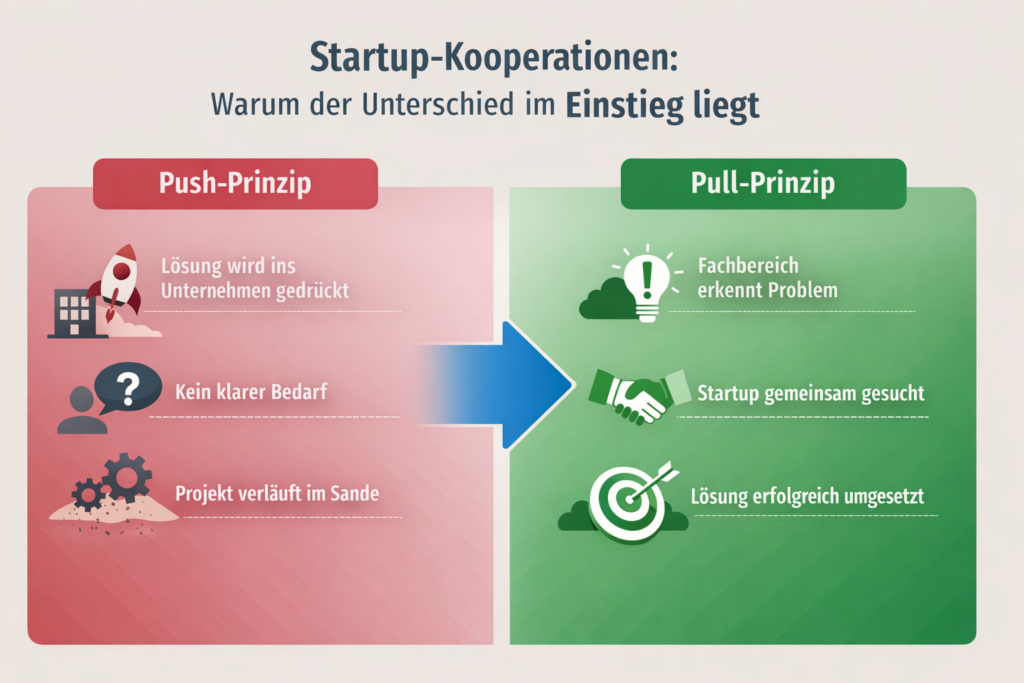
Push vs. Pull: The Key Difference in Startup Collaborations
A common approach is to actively identify startups and present their solutions internally—in the hope that this will lead to suitable use cases.
In practice, however, this approach rarely proves sustainable. Departments fail to see a clear connection to their current challenges, the concrete benefits remain unclear, and initial initiatives fizzle out. Collaborations with startups then remain isolated experiments rather than genuine drivers of value.
Pull: When the need arises from the department
Startup partnerships are significantly more successful in small and medium-sized businesses when they arise from a clearly defined need. As soon as departments can identify their challenges specifically and actively seek solutions, the initial situation changes fundamentally.
Collaboration is then no longer driven by the question of how a technology could be used, but rather by how a specific problem can be solved. This is precisely where true collaboration takes shape, and this is precisely where startups demonstrate their strength.
Many companies are now deliberately adopting this very approach as a first step toward structured venture clienting—that is, targeted collaboration with startups to address specific business challenges.
How Mid-Sized Companies Can Successfully Establish Partnerships with Startups
If companies want to work with startups not just on an ad hoc basis but systematically, they need a clear structure and a shared understanding of how the collaboration will work.
Clearly define the search field
A key factor for success is defining the search criteria as specifically as possible. The more clearly a problem is described, the easier it becomes to identify suitable startups. Especially in the context of AI, many companies have already established a very strong foundation in this area—making it an ideal time to actively pursue partnerships with startups.
Facilitate access to suitable startups
There are many ways to connect with startups—from online databases and platforms to pitch events and direct outreach. The challenge lies not so much in finding startups, but in identifying the right ones.
Especially when there is limited internal capacity for systematic scouting, it can be beneficial to collaborate with partners such as startup networks or specialized organizations. They can help identify suitable startups based on clearly defined search criteria and are often better equipped to assess whether there is a technical and cultural fit.
Clearly define responsibilities for startup partnerships
For startup partnerships to function effectively within the company over the long term, clear lines of responsibility are needed, both at the corporate level and within the various departments.
Many companies are now actively integrating this role into their structures, for example in venture clienting or within corporate innovation units. At the same time, embedding it within the business unit remains crucial, as that is where the specific need arises and where the solution must ultimately be implemented in day-to-day operations.
Enable collaboration—don’t hinder it
One aspect that is often underestimated in many companies is their own internal organization. Existing processes are frequently designed for traditional supplier relationships and are difficult to adapt to collaborations with startups. Successful partnerships with startups in the SME sector therefore require deliberate flexibility to accommodate pragmatic pilot projects, rapid coordination, and iterative approaches.
Conclusion: AI as a Catalyst for Venture Clienting and Startup Collaborations
Rarely has the timing been as favorable as it is now. Companies are taking a close look at their processes, identifying specific use cases, and are open to new approaches. It is precisely this combination that creates the ideal foundation for successful startup partnerships within the company and, for many, represents the first practical step toward structured venture clienting.
Startup Partnerships in the Context of AI – Support at the CyberForum
If you are currently exploring AI use cases and considering which initiatives to implement internally and where external partners would be beneficial, it’s worth taking a structured look at the options.
At CyberForum, we help companies identify suitable startups, establish partnerships with them, and provide practical support throughout the process. To do this, we draw on our CyberLab startup network, which offers access to a wide range of innovative AI startups and enables targeted selection based on specific use cases.

Isabel Ernst: Let’s talk about your AI use cases and potential startup partnerships.
- Head of the AI Innovation Lab
- isabel.ernst@cyberforum.de
- 0721 602 897-717