Community Management: Regional initiatives give rise to effective AI
Tobias Kenner
Published on:
The AI Alliance Baden-Württemberg consistently bases its community management on a clear principle: demand orientation instead of supply logic. The starting point for our work is not technologies or products, but the specific challenges faced by companies, municipalities, and multipliers in the state. Community management is not a communication format, but a central mechanism of the AI ecosystem in Baden-Württemberg.
From exchange to impact – why community management is crucial
Our community management pursues a clear approach: understanding needs, reducing complexity, and bringing together the right players in a targeted manner. It's not about exchange for the sake of exchange, but about concrete progress.
make real challenges visible,
identify suitable AI offerings,
and enable the transition from question to implementation.
This approach is regionally anchored and coordinated nationwide in the regions already involved – and forms the foundation of a resilient AI ecosystem in Baden-Württemberg.
For us, community management means building bridges. Between innovation and application, between experts and beginners, between questions and concrete solutions.
Regional examples: Where AI is having a concrete impact today
The initiatives from the regions show how differently AI is being used—and how similar the underlying patterns are.
Green AI & Climate Adaptation: Formats from the Stuttgart region, such as the Green AI Day and corresponding AI challenges, highlight how AI supports municipalities in climate adaptation, environmental monitoring, and data-based decision-making. Sustainability becomes an operational field of application rather than an abstract goal.
AI in the construction industry: Several regions have a clear need for AI solutions for planning, resource utilization, sustainability assessment, and risk minimization. AI is seen here as a tool for increasing efficiency and improving control.
AI for manufacturing companies: Small and medium-sized enterprises are increasingly looking for practical applications—for example, in quality assurance, production optimization, or securing skilled workers. Workshop formats offered by the cooperative ecosystem help to structure these needs and bring together suitable partners.
Textile industry in the Neckar-Alb region: The importance of industry-specific AI use cases is particularly evident in traditional industries. The focus here is on competitiveness, material efficiency, and sustainable transformation.
Smart Eco Events: AI challenges relating to sustainable events demonstrate how AI can be used in planning, logistics, energy consumption, and visitor management—with direct added value for cities and event organizers.
AI challenges: A structured bridge to implementation
A key instrument are theAI challenges set by the AI Alliance in collaboration with Fraunhofer IOSB. They translate regional needs into clearly defined questions and create a framework in which solution providers, users, and multipliers work together on specific applications.
In doing so, they are closing a crucial gap in the market: the transition from interest and idea to actual implementation.
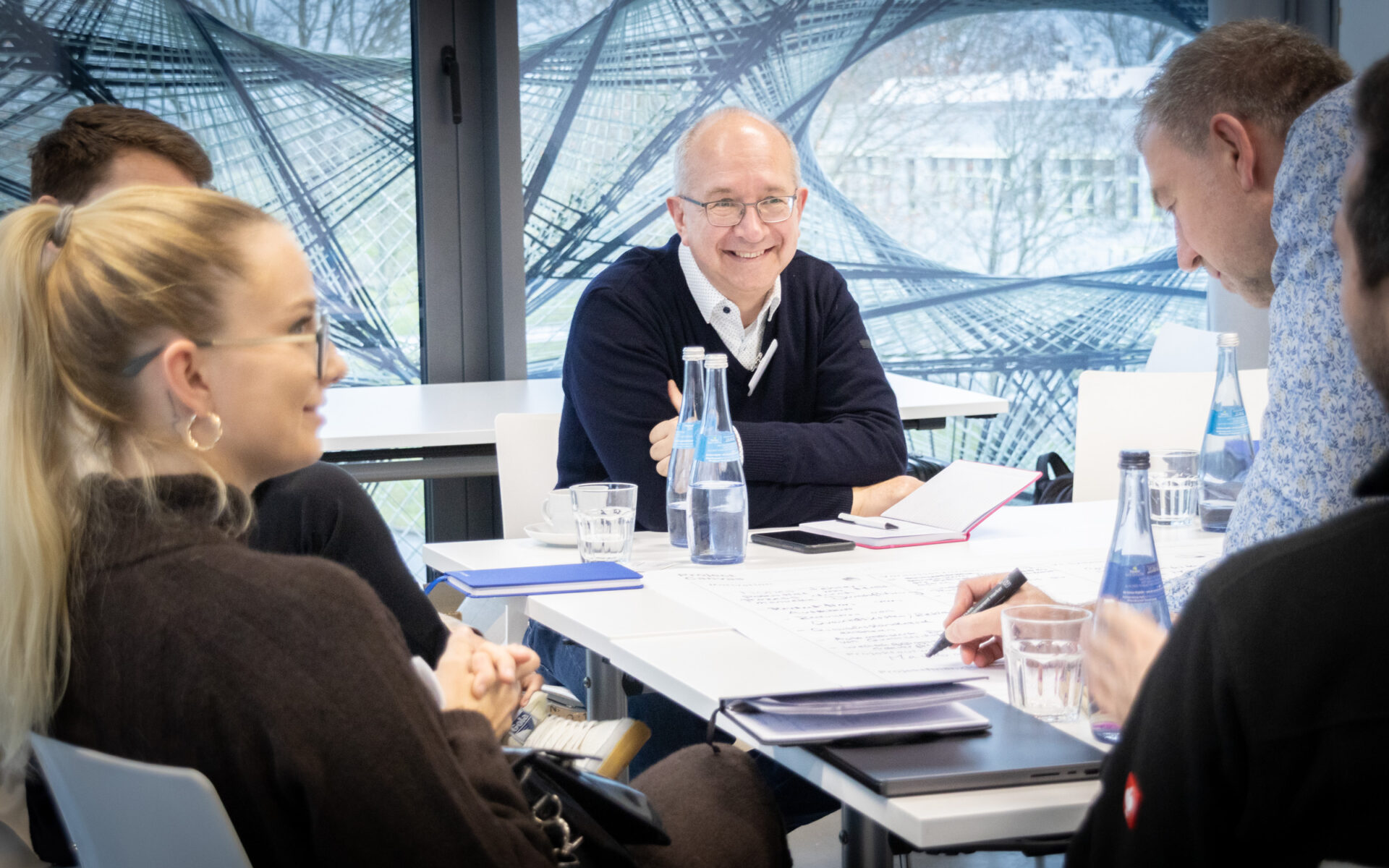
Insight into a workshop at the AI Challenge Reutlingen
What can be inferred from the regions for 2026
Across all regions, there are clear common themes that will determine the focus for 2026:
Sustainability and resilienceare becoming integral parts of AI strategies.
Practical use casesreplace abstract discussions about the future.
Regional networksremain key areas of action.
Community management is establishing itself as an enabler for transfer and implementation.
For the Baden-Württemberg AI Alliance, this means: Impact is created where regional initiatives are systematically taken up, bundled, and made available for use across regions.
Conclusion
Community management is not an add-on, but a central component of the AI ecosystem in Baden-Württemberg. It ensures that regional challenges are turned into concrete AI applications – responsibly, practically, and with a view to achieving a lasting impact in the state.
A look at the regions clearly shows that in 2026, there will be less talk about AI and more work with AI.
How an AI Agent Captures Experiential Knowledge in Customer Service Without First Documenting It: Approach, Structure, and Test Results from a Real-World Project.
Learn how artificial intelligence is transforming the economy and why partnerships and the right financing are especially important for small and medium-sized businesses.