AI in a Global Context: How International Rules and Policies Shape Practice
Sandra Schorrer
Published on:
Anyone implementing AI in their company today must consider more than just technology and use cases. International standards, political decisions, and new legal requirements are having an increasingly direct impact on business models, products, and processes. For small and medium-sized enterprises, it is therefore crucial to understand these developments early on—and to assess what they specifically entail.
International cooperation in the field of AI is evident not only in technology partnerships and the exchange of skilled workers, but increasingly also in regulatory and political processes. For small and medium-sized enterprises in Baden-Württemberg, this means that, in addition to finding the right AI solution, requirements related to security, transparency, and regulatory compliance are coming into sharper focus. International developments are setting the framework within which AI applications will be developed and deployed in the future.
In April 2025, the AI Alliance visited the Department of Automatics, Biocybernetics, and Robotics at the Jožef Stefan Institute in Slovenia as part of a technical and political delegation from Baden-Württemberg
International AI Governance and Standards
Internationalization is gaining importance in the industrial sector in part because standardized definitions and regulatory frameworks play a key role in fostering competitiveness and investment confidence. According to forecasts, the global market for industrial AI is growing rapidly—companies therefore rely on clear and, as far as possible, harmonized regulatory frameworks.
Initiatives such as the “OECD AI Principles,” international summits, and standardization processes are helping to establish common guidelines for the development and application of AI. Specific standards are also gaining importance: ISO/IEC 23894:2023 defines, for the first time, an international framework for the risk management of AI systems and supports companies in systematically integrating risks into their processes. Such standards help small and medium-sized enterprises in particular to find their way in a complex environment and to implement AI applications in a trustworthy manner.
Regulatory Changes: The EU AI Act and International Developments
With the EU AI Act, which entered into force in August 2024, the European Union has reached a major milestone in the regulation of artificial intelligence. Among other things, the goal is to prevent fragmentation within Europe and to create a unified single market for AI. At the same time, other regulatory approaches are emerging worldwide—for example, in South Korea and Taiwan—that prioritize different areas and further advance international coordination.
Political events such as the“AI Summit in Delhi”and the G7 Digital Ministers’ Meeting in Montreal also demonstrate the intensity of the discussions surrounding AI governance, trustworthiness, and international cooperation.
For companies, this creates a dynamic environment in which regulatory requirements are constantly evolving. In addition, there are other AI-related regulations. For example, the EU Machinery Directive, which will place greater emphasis on safety-critical AI functions in the future and thus have a direct impact on industrial applications.
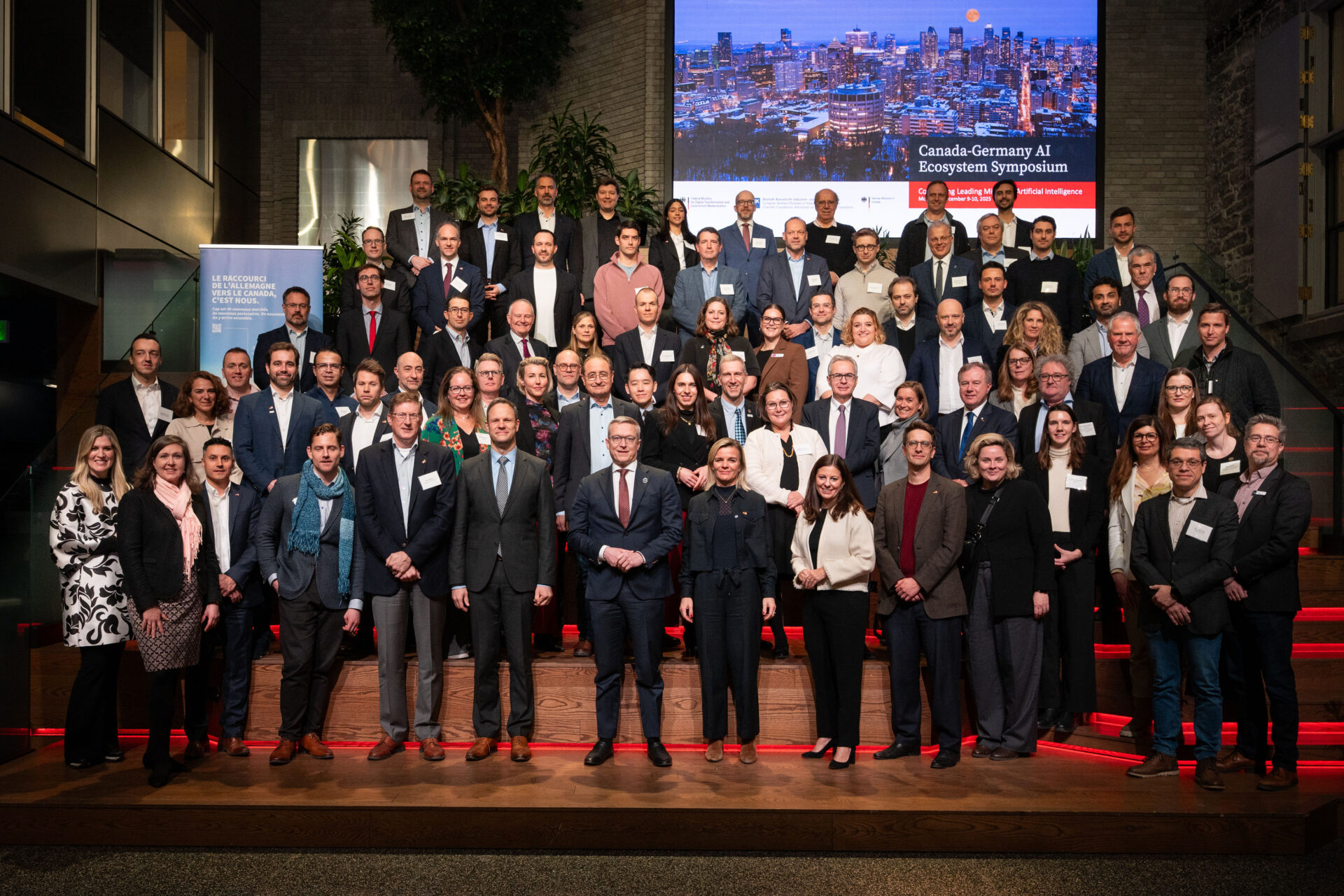
G7 meeting at the Canada-Germany AI Ecosystem Symposium 2025 in Montreal, which was also attended by the AI Alliance.
Impact on business practices
The developments described here are not limited to the theoretical or political realm; they have a direct impact on businesses. They address issues related to product development, documentation, potential certification processes, and the integration of risk management into existing workflows. At the same time, however, they also provide greater clarity and investment certainty. For small and medium-sized enterprises, this means that regulatory requirements are increasingly becoming part of operational reality—while at the same time providing guidance for reliable and scalable AI applications.
Guidance and support from the AI Alliance
For many companies, it is virtually impossible to keep track of and assess these developments in detail on a day-to-day basis. This is precisely where we at the Baden-Württemberg AI Alliance come in. We actively engage in political and regulatory dialogues—for example, in networks such as the “Four Motors for Europe” or as part of EU consultations. In this way, we help bring practical perspectives to the table.
At the same time, we help companies understand regulatory developments and implement them in practice. We do this in collaboration with partners such as IT service providers, Chambers of Industry and Commerce, TÜV AI.Lab, and specialized law firms.
This allows companies to obtain an initial assessment of their AI use cases in the context of the EU AI Act and to integrate regulatory requirements into their processes at an early stage. In addition, we offer informational and training resources and provide access to further knowledge, for example through projects or publications.
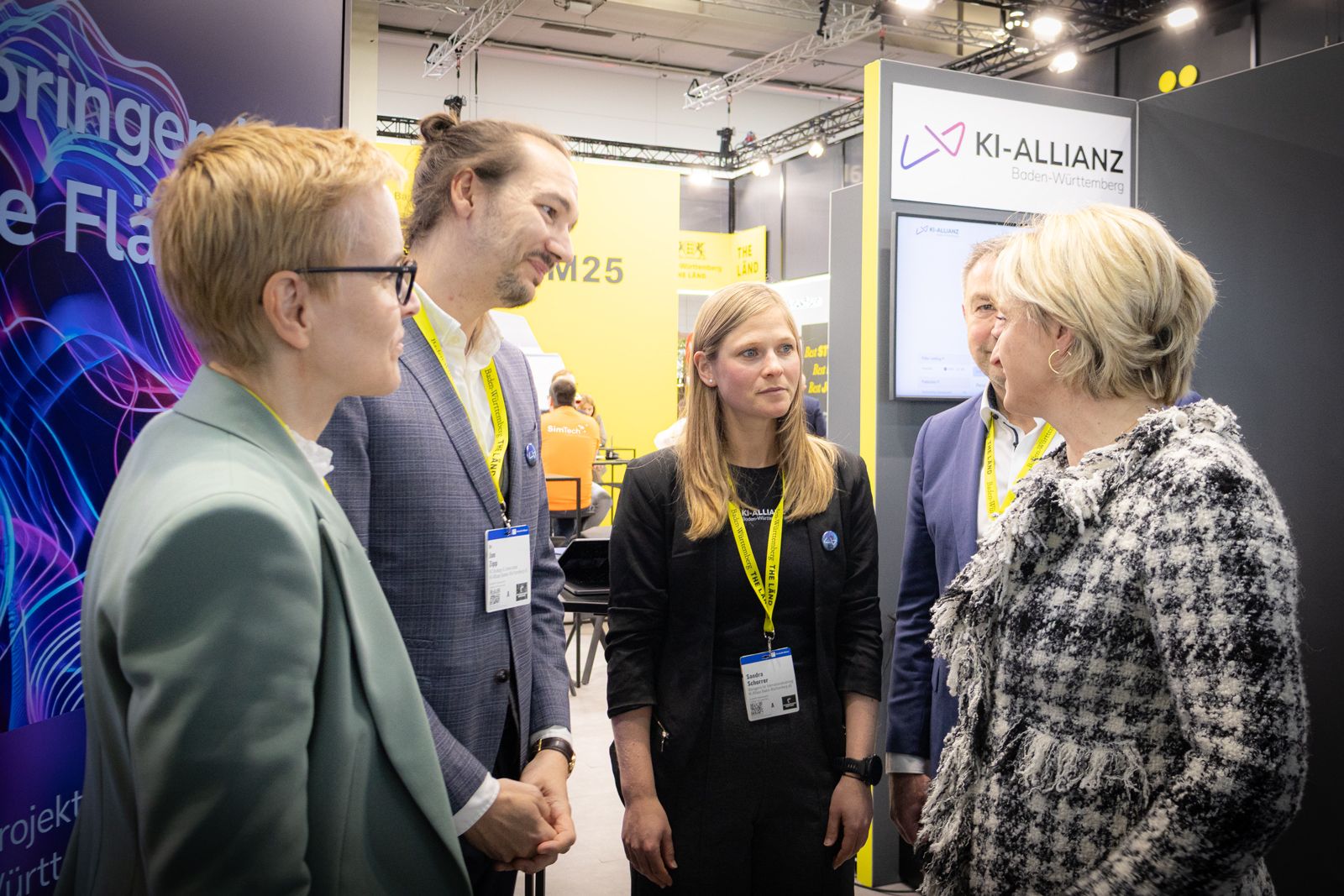
The AI Alliance in discussion with Baden-Württemberg's Minister of Economic Affairs, Hoffmeister-Kraut, at the 2025 Hannover Messe.
International Programs and New Opportunities
In addition to providing regulatory guidance, international programs open up additional opportunities. Participation in European funding initiatives or international consortia makes it possible to carry out new projects and tap into funding opportunities. This creates opportunities—particularly for smaller companies and local governments—that would often be difficult to access on their own. The AI Alliance helps identify suitable formats and initiate participation, with the goal of translating international cooperation into concrete projects and applications.
Actively analyze international developments
The regulatory and political landscape for AI will continue to evolve rapidly in the coming years. Those who understand early on how standards, laws, and international agreements are changing will be better able to assess risks and capitalize on opportunities.
As an AI alliance, we see ourselves as a partner that provides guidance and context. We pool knowledge, connect relevant stakeholders, and help translate complex developments into concrete steps for action. This creates a reliable framework within which AI applications can be implemented in a way that is not only innovative but also responsible and sustainable.
Data Rooms, Sustainability, Production Quality: How the Neckar-Alb AI Challenge Shows Where AI Is Making a Concrete Difference in the Textile Industry.
Why data sovereignty is becoming a real consideration for companies—and what role HLRS Stuttgart and SICOS BW play in Baden-Württemberg’s AI ecosystem.