

Five days in Hanover, a packed booth, a packed schedule. For us at the AI Alliance Baden-Württemberg, the 2026 Hannover Messe brought us exactly where we want to be: engaging with companies, policymakers, and international delegations. What remains are not spectacular tech demos, but a clear impression of the answers and solutions we offer for AI in the state and how companies can proactively contribute to further developing the ecosystem in a meaningful way.
Anyone walking through Hall 14 this April quickly realized that the conversation has shifted. Artificial intelligence is no longer a topic that needs to be explained at an industry trade show—but one on which everyone already has an opinion. Whether they are providers, users, research institutions, or policymakers. At the same time, it’s clear that there remains a noticeable gap between interest and implementation among small and medium-sized businesses.
This is exactly where we come in. At the joint booth of Baden-Württemberg International and the Industry 4.0 Alliance Baden-Württemberg in Hall 14, Booth J40, we served as the central point of contact for AI in the state—and after five days at the trade show, we’re bringing back a whole host of observations, conversations, and new connections. What was particularly impressive: the connections between the individual players and a reach that extends beyond the state’s borders.
What we saw in Hanover marks the next phase: moving beyond the question of whether AI is relevant—and focusing instead on how it is actually being integrated into the day-to-day operations of businesses. And that is precisely where our role and strength lie.
Tobias Kenner, Marketing & Business Development, AI Alliance
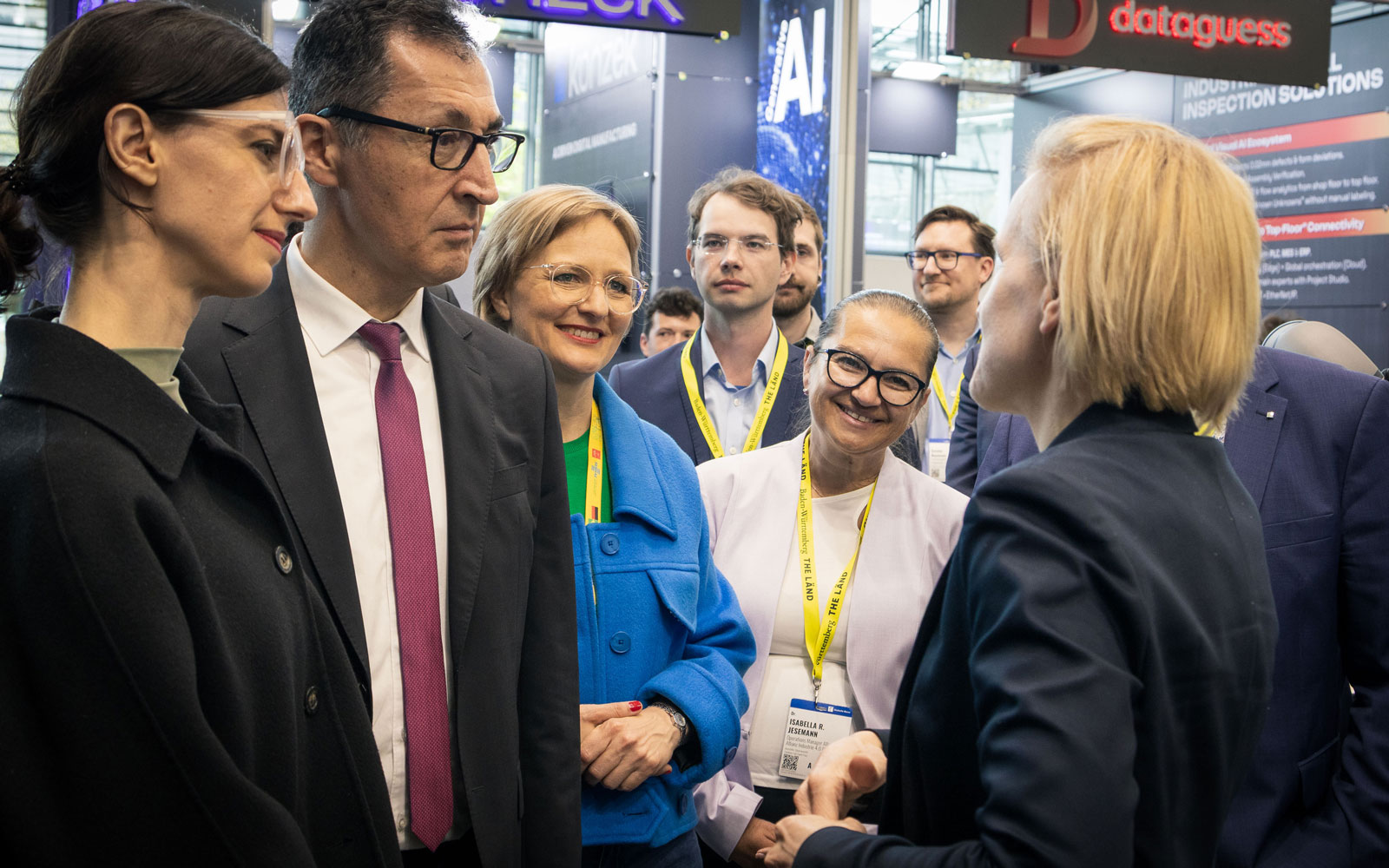
Political momentum: Özdemir and Brantner at the booth
Two prominent guests set the political tone right at the start of the trade fair week. The designated Minister-President of Baden-Württemberg, Cem Özdemir, and the Federal Chair of Alliance 90/The Greens, Dr. Franziska Brantner, visited us at our booth and demonstrated not only interest but also in-depth knowledge of AI development in Baden-Württemberg. They are already familiar with our approach and strategies for sovereignty at the regional, state, federal, and EU levels, as well as the results achieved so far by the AI data platform, and the strategic development team at the Green Party’s Economic Association considers this to be exactly the right approach.
The visit demonstrates that the AI Alliance is viewed as a model structure for other federal states.
The discussions centered on a question that kept coming up in various forms on this first day of the trade show: How can Baden-Württemberg make the leap from an AI-capable research landscape to an AI-driven economy—without leaving small and medium-sized enterprises behind?
We sense a willingness on both sides—in politics and business—to pick up the pace. What is needed in the long term are structures that systematically match needs with solutions. That is precisely our mission.
Sandra Rohner, Managing Director of KI-Allianz
International Delegations: From Matchmaking to Cooperation
As the world’s largest industrial trade fair, Hannover has always served as a forum for numerous stakeholders from around the globe who develop and apply AI in an industrial context. This was a key focus for the AI Alliance this year—and, as the person in charge of internationalization, Sandra Schorrer had a correspondingly busy schedule.
Among the guests at the booth were expert delegations from the the Netherlands, Wales, India, and Brazil as well as the international AI hardware provider NVIDIA. They were joined by a high-level delegation from Thailand, Mexico and Taiwan as well as the closed-door exchange with Canadian partners at the Germany & Canada AI Leaders Lunch and at the Canadian-German Industrial AI Symposium. In addition, B2B matchmaking with Canada as well as during the Industrial AI in Action: Matchmaking Brazil , companies from Baden-Württemberg were specifically brought together with industry and research stakeholders from these countries.
It became clear that international visibility for Baden-Württemberg as a business location is not achieved through isolated contacts, but rather through recurring, structured initiatives and cross-regional activities. With its cooperative, decentralized structure, the AI Alliance plays a central role in bringing AI to a wider audience—rooted in the region yet connected across regions.
Today, international partners are no longer looking for individual companies, but rather for ecosystems that meet their needs. If we want to position “AI made in Baden-Württemberg” on the global stage, we must offer precisely this attractive ecosystem—and that is exactly what we are doing.
Sandra Schorrer, Internationalization AI Alliance

Small and Medium-Sized Businesses: Between Aspirations and Reality
Beyond the political agenda, what truly defines the value of attending a trade show dominated the booth: long, candid conversations. The essence of these conversations is surprisingly consistent across industries. Companies recognize the relevance of AI—but face similar challenges when it comes to implementation.
It’s rarely a matter of lacking technology. It’s about a lack of direction: Which use cases are worthwhile for your business? Which providers are reputable? How can an AI solution be integrated into existing processes without disrupting them? And: How can you prevent an ambitious pilot project from turning into an expensive dead-end project?
This aligns with what we at the AI Alliance already know from our work in the regions—and what lies at the heart of what we offer: translating needs, identifying suitable partners, and assessing risks before investments are made. What sets Hannover apart is the scale of this offering: there is hardly any other place where you can have as many relevant discussions in five days as you can here.
The Hannover Messe serves as a unique barometer for the AI Alliance: over the course of five days, we gain a deep understanding of companies’ needs and can immediately connect the right stakeholders—turning casual conversations into direct networking opportunities that deliver tangible value.
Sandra Schorrer, Internationalization AI Alliance
ask-bw.io: Making AI knowledge accessible
A concrete tool designed to support this translation work was on display at the trade show: the demo of the AI knowledge and matchmaking platform ask-bw.io. Behind the simple search field lies the goal of providing an answer to the central question, “Where can I find the right AI solution for my needs in Baden-Württemberg?”—contextually relevant, quality-assured, and ad-free. This year, for the first time, it features an excerpt from the community management’s use case and service database, as well as content from the AI data platform.
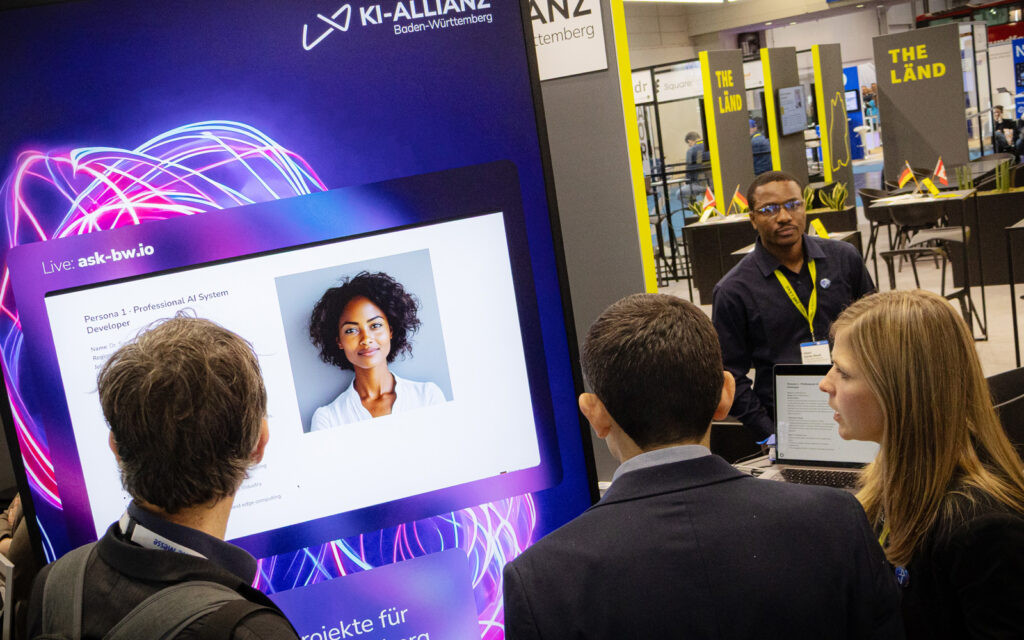
ask-bw.io at a glance
ask-bw.io is the first publicly accessible demo version of the planned knowledge and matchmaking platform. Users describe their needs in natural language and receive responses from Baden-Württemberg’s curated AI ecosystem—including references to relevant providers, research projects, funding opportunities, and events.
The response to the prototype was strong throughout all five days of the trade show—not least because it demonstrates something that many previous discussions had already suggested: The solution doesn’t need to be invented. It just needs to be discoverable.
Memberships: The cooperative is growing
The pace of membership discussions has also noticeably changed this year. The AI Alliance is organized as a cooperative—a model that focuses on participation rather than project-based logic. At the trade show, it became clear that this idea is gaining traction: numerous discussions took place with potential cooperative members, with influencers from the regions, and with providers who wish to be integrated into the AI ecosystem.
The trade show questionnaire, which we used to systematically identify needs at every booth visit, also provides a valuable foundation for follow-up work. It turns every single conversation into a documented point of contact—and thus a potential first step toward a concrete AI project.
Membership in the AI Alliance is not a passive affiliation. It is an active participation in a structure that the country needs. The companies we spoke with here understand this very well.
Tobias Kenner, Marketing & Business Development, AI Alliance

What remains—and what matters now
Hannover Messe 2026 has confirmed what we have observed in our daily work: AI does not fail in small and medium-sized enterprises because of technology, but because of structural issues—a lack of clarity, a lack of translation, and a lack of trust. Building precisely these structures is the task we continue to work on as the AI Alliance—together with partners from business, academia, and the public sector.
What we’re taking away from Hanover isn’t that one big moment. It’s the many small ones that are now turning into projects. That’s exactly what makes the difference.
Jan Zipp, Head of AI Strategy & Innovation, AI Alliance