

Many SMEs want to get started with artificial intelligence - but how?
The AI Innovation Lab's white paper "Artificial intelligence in SMEs - a practical guide to successful AI projects" provides practical assistance. In an interview, co-author Isabel Ernst explains why the first step doesn't have to be a ready-made solution - but is often a good conversation. And why internal bridge builders are needed so that AI is not just thought about, but done.

Interview with Isabel Ernst:
Isabel Ernst
Project Manager AI Innovation Lab | CyberForum
Ms. Ernst, what was the specific trigger for creating the white paper? What gap did you want to close with this guide?
Many SMEs want to get started with AI applications and initiatives in their company, but don't know exactly where to begin. This is exactly where we wanted to start: The guide is intended to provide orientation without being overwhelming. In this way, we bridge the gap between whitepapers that are either too technical and hardly accessible without prior knowledge, or are purely strategic and in turn provide little concrete guidance for implementation. Instead, our white paper offers practical guidance for small and medium-sized companies.
Who is the guide aimed at - and with what intention?
Our aim was to address decision-makers, digital managers and innovation officers from small and medium-sized companies in particular. The guide is intended to help them recognize potential, involve employees and plan realistic first steps.
What experiences from everyday life at the AI Innovation Lab have been directly incorporated into the paper?
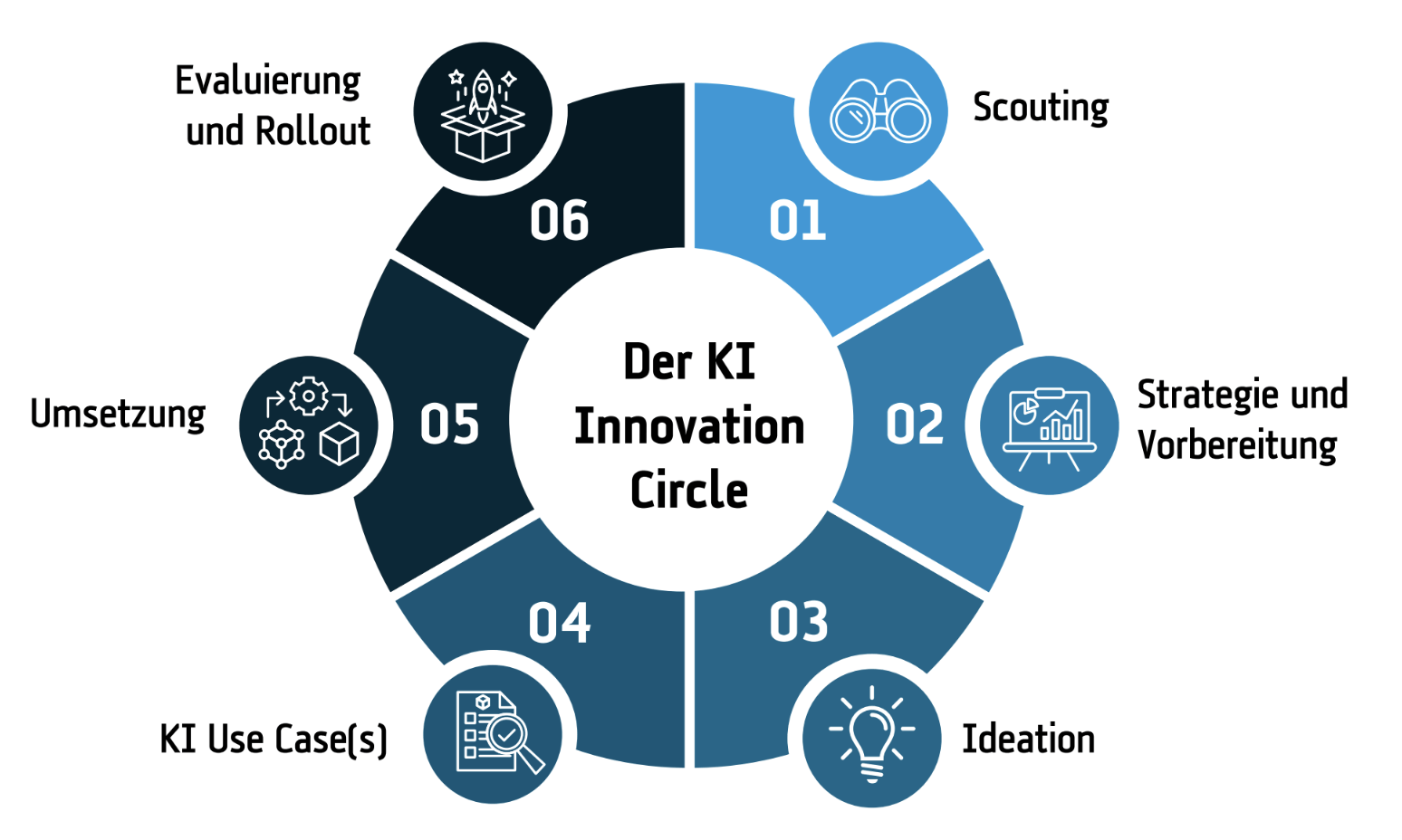
A great many. We work with companies on a daily basis that have very different requirements. The "AI Innovation Circle", as we build it up in the white paper, is based on typical project processes of our customers.
Please tell us more about the AI Innovation Circle. What is the idea behind it?
The AI Innovation Circle describes six phases that have proven to be helpful in practice: from the initial orientation to the scaling of AI applications. It is designed to help companies see an AI project not as a one-off technical measure, but as a strategic learning process. It was important to us that companies do not have to start at phase 1. The Circle is therefore structured in such a way that you can join at any time or dock on at the right point.
In your experience, which of the six phases is most often underestimated by companies - and why?
In fact, there is no general answer to this question, as each phase has its own pitfalls. What we often observe, however, are obstacles in the ideation phase and scaling after the first proof of concept.
The ideation phase is about identifying suitable use cases. What often begins as creative brainstorming often ends in uncertainty: which idea is feasible, brings real added value and can really be implemented internally? Many companies find it difficult to make a well-founded selection from the multitude of possibilities.
At first glance, the scaling phase seems like a technical connection, but it is often the most strategic hurdle. A proof of concept is quickly realized in a test environment with a limited scope. But then fundamental questions arise: Who takes responsibility for the rollout? How will it be integrated into existing processes and systems? And where will the budget come from? If these questions are not addressed at an early stage, implementation often fails not because of the technology, but because decisions are not made.
Were there any surprising findings or recurring patterns that stood out to you during the creation of the guide?
One of the key findings was how crucial internal drivers are for the success of AI projects. In almost every project that was actually implemented, there was someone in the company who drove the topic forward with conviction, regardless of the hierarchical level. The guide is intended to help precisely these people to gather arguments, create structures and effectively position the topic within the company.
Which misconception about "AI in SMEs" would you like to dispel once and for all with this white paper?
A common misconception is that small and medium-sized companies should wait and see. Every industry, every company and every process is different. That's why SMEs should start today with their own questions and at their own pace.
In your opinion, what are the most important prerequisites for an AI project to succeed in a small or medium-sized company?
Firstly, a clear strategy, and by that we don't mean a comprehensive thesis paper, but a realistic framework: Where do we want to go, what problem do we want to solve, what budget is available and is the management behind it? Secondly, we need an internal driver who actively promotes the topic. These "bridge builders" are often the decisive success factor. And thirdly, employees need to be involved right from the start. AI changes processes, roles and working methods. Those who provide information at an early stage, take fears seriously and work together on solutions lay the foundation for acceptance and successful implementation.
How can employees be taken along on this journey - even beyond technical issues?
For AI projects to be successful, it is important not only to inform employees, but also to actively involve them. This starts as early as the ideation phase: many companies have had good experiences with setting up internal AI working groups. At the same time, there needs to be space for knowledge and exchange, for example through internal training courses, learning lunches or awareness formats.
What role will the AI Innovation Lab play in the implementation of AI projects in the future - especially in the context of the Baden-Württemberg AI Alliance?
We see ourselves as a sparring partner for SMEs and a "bridge builder" to technology providers and service providers. Through the AI Alliance, we are also part of a strong ecosystem that gives companies access to expertise, partners and funding opportunities. Our role is to make getting started as practical as possible and to connect them with the right offers and partners.
If you had to name three words that sum up the white paper - what would they be?
Structure, because a clear roadmap creates security. Relevance , because every company has to find its own path to AI. Responsibility, because AI is not an IT project, but a strategic issue.
Would you like to get started right away and find out more?
Then download the new, free white paper from the AI Innovation Lab at the following link:

About Isabel Ernst
Isabel Ernst is project manager of the CyberForum's AI Innovation Lab, a sub-project of the AI Alliance. There, she supports SMEs on their way to practical AI applications. Thanks to her experience as a former start-up founder and previous work in innovation management and business development, she combines different perspectives on innovation and digital business models. Her focus is on identifying innovation potential, developing it strategically and transforming it into viable business models.