AI Infrastructure from Baden-Württemberg: Computing Power Made in Stuttgart
Tobias Kenner
Published on:
Artificial intelligence requires data, models, and expertise. Above all, however, it needs one thing: computing power. When it comes to this, many companies first think of the major international cloud providers. But high-performance AI infrastructure is also available in Germany—and a key location is right on our doorstep: the Stuttgart High-Performance Computing Center, or HLRS for short. A key player in the surrounding ecosystem is SICOS BW, a member of the AI Alliance cooperative.
Sovereignty: From a Buzzword to a Genuine Consideration
Just a few years ago, data sovereignty was an issue that many companies agreed on—only to end up choosing the cheapest solution anyway. Dr. Andreas Wierse, managing director of SICOS BW, has observed this shift up close over the past 15 years: “In the past, everyone would nod in agreement when we talked about sovereignty. But as soon as money came into the picture, it suddenly wasn’t an issue anymore.”
That has changed. Geopolitical uncertainties, shifting dependencies, and—not least—real-world experiences with supply chains and digital infrastructure have led companies to approach the question of where their data is stored and who can access it differently today. Not as a matter of principle—but as an operational decision.
When we talk today about the fact that the data is stored here in Stuttgart and that we know who we’re dealing with, we realize that this has become significantly more important to companies.
Sovereignty is rarely the primary driver behind an AI project. However, it becomes a decisive factor when it comes to implementation and long-term planning—along with data protection, compliance, costs, and the issue of vendor lock-in.
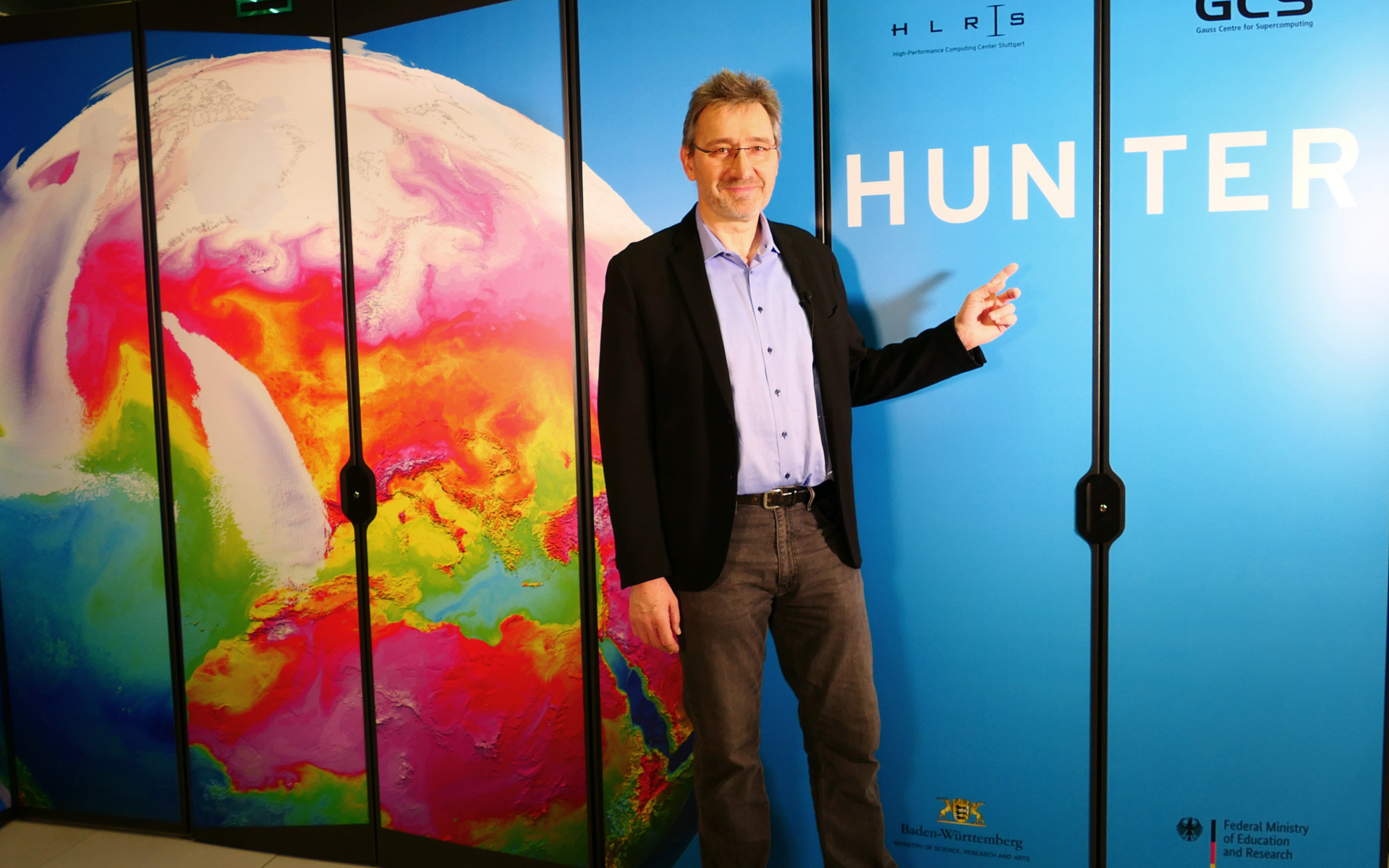
Dr. Andreas Wierse in front of "Hunter," the current flagship supercomputer at the Stuttgart High-Performance Computing Center (HLRS).
What's Actually Available in Stuttgart
For companies, however, this infrastructure is not self-explanatory. The reason lies in the nature of the facility: As a public high-performance computing center, the HLRS is subject to a clear legal framework—including regulations regarding export controls. The University of Stuttgart is responsible for ensuring that these regulations are followed. This means that anyone who wants to run computations on the system must identify themselves, sign a contract, and accept the terms of use. It’s more involved than a single click—but it also ensures full transparency regarding who is allowed access and who is not.
Infrastructure Requires Mediation
High-performance computing, data analysis, and AI are increasingly converging. For Wierse, the transition between them is seamless: “There is a continuum: It starts with statistics and extends through data analytics and machine learning all the way to artificial intelligence. The transition is not sharply defined.”
This is an important distinction for companies. Not every AI project starts with a large language model. Often, the initial focus is on better understanding existing data, analyzing processes, or speeding up simulations. This is exactly where SICOS BW comes in: not as a technology provider, but as a neutral facilitator—connecting small and medium-sized businesses, research, and infrastructure.
This advocacy work does not stop at the state border. SICOS BW is active in European associations—including the European Technology Platform for HPC and the Big Data Value Association—where it represents the perspective of small and medium-sized enterprises. Wierse contributes as a co-author to white papers that serve as a basis for the EU’s policy decisions in the areas of high-performance computing and AI. What may appear to be mere networking in day-to-day business thus serves a concrete strategic function: By helping to shape the framework conditions, SICOS BW plays a role in determining the conditions under which AI infrastructure will be available in Europe in the future.
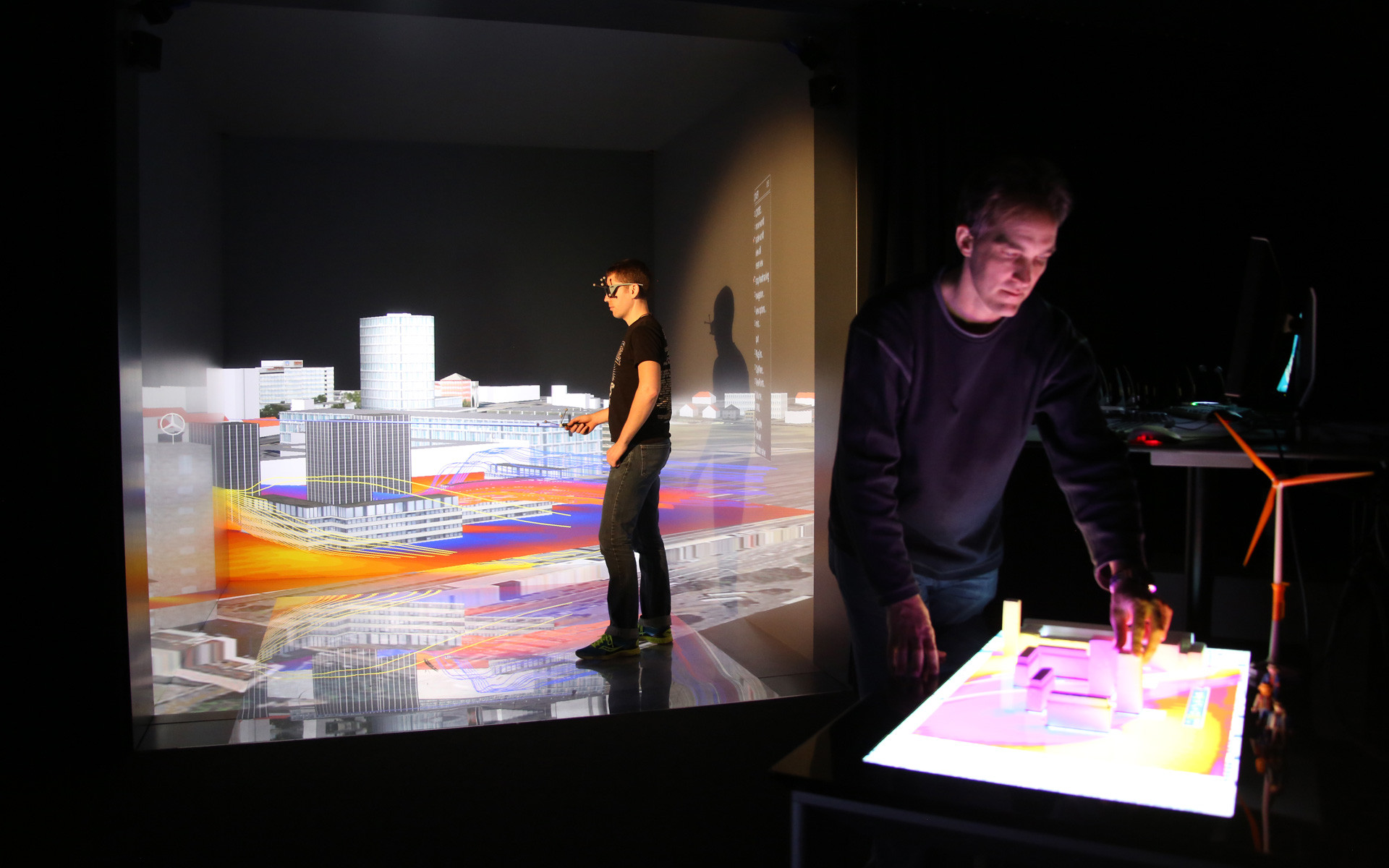
The conversion of large, complex datasets into three-dimensional, interactive digital environments makes it possible to observe, navigate, and manipulate objects and virtual spaces in ways that are unimaginable in the real world.
Stuttgart Continues to Expand
HammerHAI marks a new phase of development at HLRS: Germany’s first AI factory as part of the European EuroHPC program, set to begin operations in April 2025. The goal is to further lower the barriers to entry for startups, SMEs, research institutions, and public organizations. SICOS BW is one of the strategic consortium partners.
The goal behind this is the same one that has driven SICOS BW for the past 15 years: to provide guidance, facilitate access, and connect the needs of the business community with the appropriate infrastructure and expertise. After all, high-performance local AI infrastructure is only useful if companies know how to use it—and why it’s worth it.
About Dr. Andreas Wierse
Dr. Andreas Wierse has been the managing director of Sicos BW GmbH in Stuttgart since its founding in 2011. The company was founded by the Karlsruhe Institute of Technology and the University of Stuttgart to serve as a bridge between cutting-edge research and small and medium-sized enterprises (SMEs), and it provides small and medium-sized enterprises with impartial, independent, and free advice on getting started with high-performance computing, simulation, data analysis, and artificial intelligence. Over the past 15 years, this has resulted in more than 150 projects and initiatives. Since 2014, Wierse has also led hww GmbH, a public-private partnership in high-performance computing with the state of Baden-Württemberg, Porsche, and T-Systems as shareholders. A mathematician with a Ph.D., he has been working on visualization and virtual reality since the 1990s, most recently as co-founder and managing director of Visenso GmbH, and is co-author of the “Smart Data Analytics Practical Handbook.”
Dr. Andreas Wierse has been a member of the Supervisory Board of KI-Allianz Baden-Württemberg eG since June 2026.
An interview with Jürgen Weber of weber.cloud: Where SMEs really stand when it comes to AI, why free credits are a trap—and what a first meaningful step actually achieves.
How does AI help address the skilled labor shortage in Baden-Württemberg? Ina Biesenbach explains the state project “AI Can Do It”—and what companies can take away from it.