

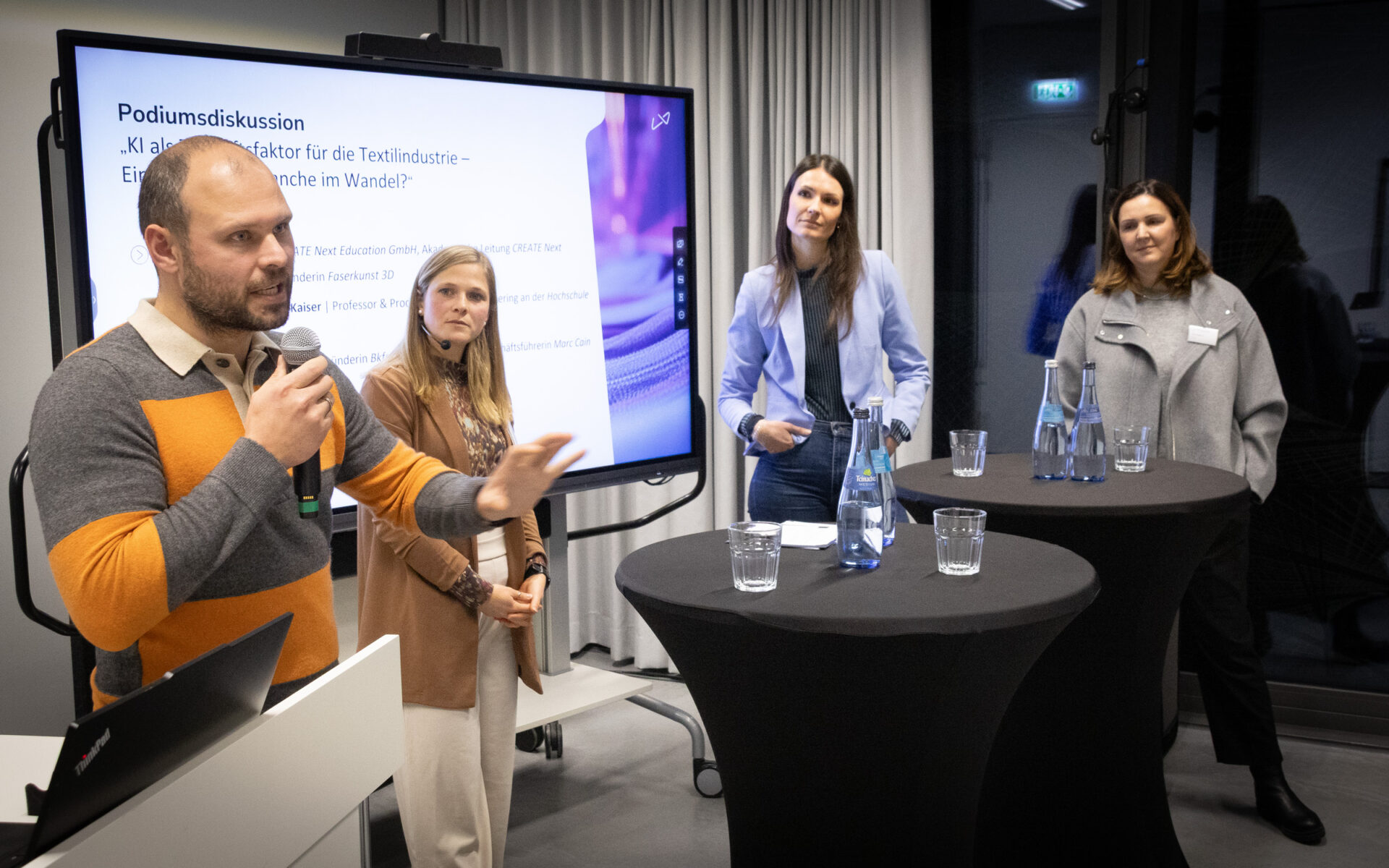
Machinery fleets spanning several decades, tight digitization budgets, and pressure to transform everything from design to logistics: The textile industry in the Neckar-Alb region faces challenges that cannot be addressed with a single solution. That is precisely why, for our AI Challenge “AI as a Future Factor for the Textile Industry,” we brought together industry experts and AI specialists—in collaboration with Fraunhofer IOSB and a broad coalition of regional partners, ranging from the Reutlingen Chamber of Commerce and Industry to Texoversum.
Six concrete project ideas emerged from three thematic strands. One participant summed up what was particularly important in this process:
“The AI Challenge is a forward-looking initiative that gives startups access to industrial companies. This direct exchange creates a framework that allows for genuine depth of discussion.”
Marie Weedermann, FAIBRICS
When Measurement Errors Lead to Defective Production
Whether for custom-made medical products such as compression stockings or new textile designs, incorrectly recorded body measurements or inappropriate material combinations regularly lead to production errors and time-consuming follow-up inquiries; and plausibility checks have so far depended heavily on the experience and daily performance of individual employees. The “AI-Based Plausibility Check” project is designed to provide support in both areas: It automatically checks measurement and material data for plausibility without taking decision-making away from the specialists. “DigitAllSample” takes a similar approach, but in the design phase: Instead of producing elaborate sample collections on a hunch, the system uses historical test data to predict whether a new design is even suitable for mass production, thereby sparing suppliers and customers alike from costly failed attempts.
Sustainability Becomes a Reporting Requirement
With new EU regulations such as the CSRD, the effort required for textile companies to comprehensively document sustainability is also increasing. Consolidating data from a wide variety of systems has, until now, been time-consuming and error-prone. This is where the “AIassure” project comes in: a language model-based reporting system that aggregates sustainability data from a central source and automatically adapts to new regulatory requirements. This transforms a cumbersome mandatory task into a process that can be updated at the push of a button. An order passes through multiple resource levels in production—yet only the first step is digitally recorded in the ERP system. All subsequent supply steps often still rely on paper work orders and verbal coordination, without logistics or production knowing in real time where materials are available or which order takes priority. The result is long walking distances and unnecessary downtime, during which machines have to wait for replenishment that no one reports in a timely manner. The “LOG-AI” project addresses precisely this aspect of warehouse logistics: Using tags, the system locates load carriers directly in front of the machines and automatically generates a dynamic, prioritized order list—digital control instead of verbal instructions and paper cards.
Stagnation becomes the exception
Whether in yarn dyeing, fault diagnosis, or the manufacture of medical compression stockings: Unplanned downtime and hard-to-capture experiential knowledge regularly cost textile manufacturers time and quality. What’s striking is that compression stockings appear in two of the six project ideas—an indication of just how prominent this sector actually is in the region. “TexMaintAIn” monitors machine components in the dyeing plant using sensors and detects wear before it leads to a breakdown. “PROFA” relies on a RAG system (Retrieval-Augmented Generation): A knowledge database of documented errors and proposed solutions forms the foundation, while a language model serves as an interface through which employees can ask for solutions using natural language—thereby preserving experiential knowledge even after individual employees leave the company.
“StruMon 4.0” specifically monitors the production of compression stockings: Optical measurement technology records machine speed, yarn tension, knitting speed, and temperature directly at the circular knitting machines, in some cases inline during production. If a value deviates from the target—for example, in terms of stitch pattern, fabric length, or pressure distribution—the system immediately alerts the operating personnel, because even the slightest deviations can compromise the medical effectiveness of the product.
What Matters in the End
Six project ideas, three thematic areas, one common thread: AI will never replace the industry’s experiential knowledge. It makes that knowledge more visible, verifiable, and easier to delegate. Whether AI-based plausibility checks, DigitAllSample, AIassure, TexMaintAIn, PROFA, and StruMon 4.0 will become concrete projects is now being decided in the region.
Neckar-Alb was the fourth stop in our AI Challenge series—following Karlsruhe, Stuttgart, and Freiburg, two more regions have since joined the series, each with its own themes.
Learn more about the AI Challenge “AI in the Textile Industry”